
Does Hot Tea Stain Teeth More Than Cold Brew?
I’ve been a daily tea drinker long enough to know that staining is not just a theoretical worry. I’ve seen it in my own bathroom mirror after years of morning cups. The question I kept coming back to was simple: does hot tea stain teeth more than the cold brew I eventually switched to. What I found surprised me. The connection between brew temperature and how much staining actually builds up turned out to be far more direct than most people realize.
Tea and Tooth Staining: The Short Version
Does tea stain the teeth, and why does the answer shift depending on how you brew it. Tea leaves naturally contain tannins, a broad class of polyphenols responsible for the characteristic astringency you feel in a strong cup. What makes tannins particularly relevant to dental health is their chemical reactivity with proteins. Your tooth enamel is coated in a thin protein film called the acquired pellicle, and tannins bind to it readily. Once anchored to that film, they create attachment sites for chromogens, the pigmented molecules that produce the visible discoloration that accumulates on enamel surfaces over time.
Tea is also mildly acidic, and that acidity temporarily softens enamel and increases its porosity. More porous enamel absorbs pigments more readily, which means the acid and the tannins work in combination. One primes the surface for penetration, and the other delivers staining compounds to enamel that has been made more receptive (Watts & Addy, 2001). The discoloration that builds over months and years of daily drinking is the cumulative result of these two mechanisms reinforcing each other with every cup.
Different teas produce noticeably different staining outcomes through this same underlying process. The gray-toned discoloration pattern typical of regular green tea consumption traces to the same tannin-chromogen pathway as black tea staining. The difference lies in the tannin profile and the specific pigments involved, not the mechanism (Guo et al., 2023).
Sandy’s Science Corner: Tannins as Molecular Anchors
The acquired pellicle, a thin protein film that reforms on enamel within minutes of brushing, cannot be permanently removed. Tannins contain multiple hydroxyl groups that form stable hydrogen bonds with the proline-rich proteins in this film, creating docking sites for chromogens to accumulate. The process is incremental: each cup contributes a small amount, and the staining deepens over time. Crucially, this is surface chemistry, not structural enamel damage. That distinction matters because professional cleanings can fully reverse it, no structural repair needed (Nathoo, 1997).
How Hot Water Changes What Ends Up in Your Cup
The temperature of your brewing water does more than determine how quickly your tea steeps. It fundamentally changes the chemical composition of what ends up in the cup.
At temperatures between 80°C and 100°C, hot water functions as a highly efficient solvent for polyphenols. The thermal energy breaks down cell wall structures in the tea leaf more aggressively, driving a faster and more complete release of tannins, catechins, and other compounds into the water. Research on polyphenol and catechin extraction in Camellia sinensis demonstrates that extraction efficiency climbs sharply as temperature rises above 60°C, with hot water yielding concentrations of staining compounds that cold water cannot approach at comparable steep times (Perva-Uzunalić et al., 2006).
Steep time compounds this considerably. The longer tea steeps at high temperature, the more it continues extracting progressively larger, more astringent tannin molecules, the same compounds with the strongest binding affinity for the enamel pellicle. This is why over-steeped tea both tastes more bitter and stains more aggressively, since the two effects share the same root cause in extraction chemistry. The relationship between how long black tea sits in hot water and the tannin concentration of a finished cup is direct and measurable, and it shapes the staining potential of every serving you drink.
It is also worth noting that hot water extracts at higher levels across the full range of compounds in the leaf, including flavor compounds, caffeine, antioxidants, and pigments alike. Brewing green tea cold instead of hot changes more than just staining potential. The shift to cold changes the chemistry of the entire cup, with the reduced tannin yield being one notable benefit within a wider set of differences.
Cold Brew vs. Iced Tea: Why the Difference Actually Matters
Most tea drinkers assume that drinking tea cold is what protects their teeth. This assumption misses the more important variable entirely.
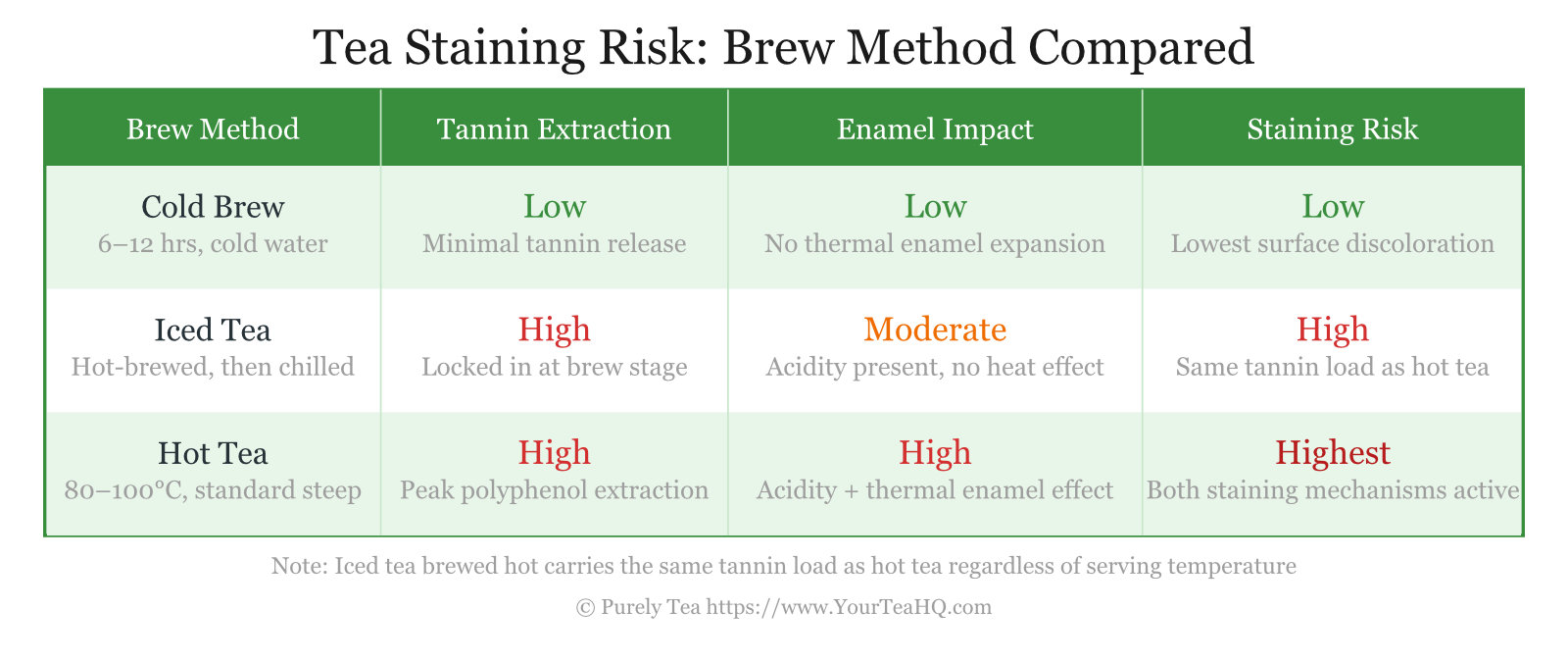
Cold brew tea and iced tea are chemically distinct products. Cold brew is made by steeping leaves in cold or room-temperature water for an extended period, typically six to twelve hours, often overnight in the refrigerator. The slow, low-energy extraction produces a cup with fundamentally lower concentrations of tannins and chromogens. The staining compounds are simply not mobilized to the same degree by cold water as they are by hot.
Iced tea, by contrast, is almost always brewed hot and then either chilled or poured directly over ice. It may arrive cold in the glass, but its chemical composition was determined at the kettle. The tannin concentration in a glass of iced black tea is essentially the same as in the original hot cup, since chilling the liquid does not extract or neutralize staining compounds that are already dissolved in the water. Steep time and water temperature during brewing determine the staining load per cup, not the temperature at which you consume it.
This is the distinction that determines whether cold tea actually protects your teeth. So does hot tea stain teeth more than true cold brew. Cold water pulls far fewer staining compounds out of the leaf from the very start, and that gap in extraction is really the whole answer. Switching from hot tea to commercially produced bottled iced tea accomplishes nothing for staining reduction, since that bottled tea started life as a hot brew. Making true cold brew at home, where cold water does the work from the beginning, produces a genuine and measurable difference in what your enamel encounters with each cup (Wu & Wei, 2002; Perva-Uzunalić et al., 2006).
Cold brew tea is also naturally lower in acidity than its hot-brewed equivalent, which weakens the second staining mechanism. Less acidity means less temporary softening of enamel, and a less porous surface for chromogens to settle into. The two effects stack. Fewer tannin anchors form at the pellicle, and enamel is less chemically receptive when the chromogens arrive. Anyone asking does tea stain the teeth less when it is brewed cold is really asking about both mechanisms at once, and here they both point in the same direction.
The Temperature-Enamel Connection
There is a second mechanism that links hot tea to increased staining risk beyond tannin concentration alone, and it gets considerably less attention than it deserves.
Hot liquids produce a brief thermal response at the tooth surface. When hot tea contacts enamel, the surface layer expands slightly in response to the heat, temporarily increasing the size and accessibility of micro-channels within the enamel matrix. This transient expansion creates a surface that is measurably more receptive to pigment penetration than enamel at resting temperature. The mechanism is well understood in clinical dentistry. It is the same principle applied when heat is used to open enamel pores before professional whitening treatments (Watts & Addy, 2001).
Cold brew bypasses this entirely. There is no thermal expansion, no transient increase in enamel porosity, and no surface preconditioning before the lower-concentration chromogens arrive. The enamel simply encounters a cooler, lower-tannin liquid under conditions that do not increase its own susceptibility to staining.
No single cup of hot tea causes serious structural damage through this mechanism. But accumulated across thousands of cups over years of daily drinking, the difference between thermally primed, high-tannin exposure and cold, lower-tannin exposure becomes visible. It is precisely what many people who switch to cold brew begin to notice in the mirror after a few consistent months of making the change.
Which Teas Benefit Most from Cold Brewing
Not all teas respond the same way to cold brewing when staining is the primary concern, because the staining mechanisms are not identical across all tea types.
Black tea has the most to gain. It carries the highest natural tannin concentration of any common tea variety, and hot water extracts those tannins with exceptional efficiency. The gap between the cold-brewed and hot-brewed tannin yield is larger for black tea than for any other variety, which means the staining reduction from switching brew methods is also most significant here. It is also worth noting that black tea’s broader relationship with gum and cavity protection extends well beyond staining, since its polyphenol content shows meaningful activity against the bacteria involved in cavities and gum disease, making its oral chemistry considerably more nuanced than its staining reputation alone would suggest.
Green tea shows a meaningful but more moderate benefit from cold brewing. Its tannin baseline is lower than black tea to begin with, and cold water extraction further reduces the concentration of catechins and smaller tannin molecules responsible for its characteristic gray discoloration pattern.
White tea is already among the lowest-risk teas for staining under either brew method. Its minimal processing leaves it with one of the lowest tannin profiles of any traditional tea, and cold brewing nudges that already-modest baseline down further, though the practical change is minor compared to the shift seen with black tea.
Herbal teas are a distinct case. Most herbal blends stain through natural pigments rather than tannins. Hibiscus, rooibos, and berry-based blends color teeth through the same pathways that beets and red wine do. Cold brewing does reduce some pigment extraction in these blends, but the effect is considerably less pronounced than it is with tannin-heavy teas. For herbal blends, straw use and prompt water rinsing after drinking are more useful interventions than brew temperature.
Ashley’s Note: My Cold Brew Routine
My setup is almost embarrassingly simple. A tablespoon of loose-leaf black tea in a mason jar, filled with cold filtered water, lid on, left in the fridge overnight. By morning it is ready to strain and drink. I always use a straw, one small habit that keeps the tea away from my front teeth, and I rinse with plain water after the last sip. I noticed a real difference in how my teeth looked within about a month of starting this routine, and I have not brewed hot tea for my daily cup since.
One Practical Swap Worth Making
If you drink tea every day and staining is something you keep returning to, changing your brew method is the most impactful single adjustment you can make. Whitening toothpastes and rinse habits help, but they work downstream of the brewing step, managing the staining aftermath after it has already occurred. Cold brew addresses the problem at its source by reducing what actually reaches your teeth in the first place.
Drinking through a straw adds to this benefit by reducing direct contact between the liquid and your front tooth surfaces, where surface discoloration is most noticeable. Rinsing with plain water after the last cup of the day clears residual tannins from the oral environment before they have time to set into enamel. It takes about five seconds and is one of the most consistently overlooked habits among daily tea drinkers.
For those who drink hot tea regularly and are not ready to switch brew methods, timing is the most important variable to manage. Enamel is temporarily softened after any acidic drink, and brushing during that window increases the risk of surface abrasion. Waiting at least thirty minutes before brushing reduces that vulnerability considerably. Building out a fuller prevention routine for regular tea drinkers, from brushing timing to product choices and routine dental cleanings, gives daily tea drinkers the most complete toolkit for protecting their teeth without abandoning the cup.
Conclusion
Does hot tea stain teeth more than cold brew. The honest answer comes down to what is in the cup, and what is in the cup is largely determined before the first sip. Brew method sets the tannin load, and the temperature at which you drink it is almost irrelevant. Cold brew changes the chemistry upstream, and that upstream change has visible effects for anyone drinking tea every day. The jar in the fridge overnight might be the simplest and most effective thing you can add to your routine if you want to keep both the habit and your smile.
Disclaimer: The information on Purely Tea is for educational purposes only and is not intended as medical advice. Always consult with a healthcare professional before making changes to your diet, especially if you have underlying health conditions.
References
- Guo, Y., Li, Z., Chen, F., & Chai, Y. (2023). Polyphenols in oral health: Homeostasis maintenance, disease prevention, and therapeutic applications. Nutrients, 15(20), 4384.
- Nathoo, S. A. (1997). The chemistry and mechanisms of extrinsic and intrinsic discoloration. Journal of the American Dental Association, 128(Suppl), 6S-10S.
- Perva-Uzunalić, A., Škerget, M., Knez, Ž., Weinreich, B., Otto, F., & Grüner, S. (2006). Extraction of active ingredients from green tea (Camellia sinensis): Extraction efficiency of major catechins and caffeine. Food Chemistry, 96(4), 597-605.
- Watts, A., & Addy, M. (2001). Tooth discolouration and staining: A review of the literature. British Dental Journal, 190(6), 309-316.
- Wu, C. D., & Wei, G. X. (2002). Tea as a functional food for oral health. Nutrition, 18(5), 443-444.
