
Drinking Tea on an Empty Stomach: What Really Happens Inside Your Body

Most mornings, the kettle goes on before anything else does. It is a reflex for a lot of us — roll out of bed, reach for the tea, and only think about breakfast later. For years, I did exactly that. It was fine, until it wasn’t — a low-level nausea that I couldn’t quite place, a vague hollowness that sat wrong in my stomach. Drinking tea on an empty stomach felt harmless, but the body was giving me a pretty clear signal that something was off.
Why an Empty Stomach Changes Everything
The stomach does not sit neutral while it waits for food. Even before you take a sip of anything, your digestive system is already producing a baseline level of hydrochloric acid — around pH 1.5 to 3.5 depending on the individual — ready to break down whatever arrives. This is normal and healthy. What changes when you drink tea without eating first is the scale of the acid response and the absence of anything to buffer it.
Food does more than just give the acid something to work on. It physically coats the stomach lining, dilutes the acid concentration, and the proteins in food bind to tannins before those tannins reach the gastric mucosa — the delicate inner lining of your stomach. Without that buffer, tea compounds arrive at full concentration and the stomach reacts accordingly.
Whether it is bad to drink tea on an empty stomach depends heavily on these variables. Some people drink black tea every morning before eating and feel completely fine. Others notice nausea after the first cup. The difference usually comes down to how sensitive their gastric lining is, how strong they brew, and which tea they’re reaching for. That last variable matters more than most people realize.
The Tannin-Acid Problem (And Why Nausea Happens)
Tannins are polyphenolic compounds found in all true teas — black, green, white, and oolong. They are the reason tea has that dry, slightly astringent quality, particularly when brewed strong. When you drink tea, tannins bind to proteins wherever they encounter them. On a full stomach, they are mostly meeting the proteins in your food. On an empty stomach, the proteins they meet first belong to the mucous lining of your stomach wall.
Research has documented tannins’ ability to form complexes with tissue proteins on contact (de Jesus et al., 2012). In low concentrations with food present, this interaction is largely benign. Without food, concentrated tannins landing on an unprotected gastric mucosa can cause real irritation in sensitive individuals.
Caffeine compounds the problem. Research from the University of Vienna found that caffeine activates bitter taste receptors in gastric parietal cells — the cells responsible for producing hydrochloric acid — directly stimulating acid secretion (Liszt et al., 2017). So tannins irritate the mucosal lining, and caffeine tells the stomach to produce more acid at the same time. Without food to absorb any of this activity, the result for a lot of people is nausea, a burning sensation, or just a general unease that is hard to attribute until you connect it to the timing of your first cup.
A 1984 study measured the gastric acid response to tea in healthy volunteers and in patients with duodenal ulcers, finding that plain tea without milk or sugar produced an acid response that exceeded even maximal histamine stimulation. Adding milk significantly reduced this response (Dubey et al., 1984) — a practical point we will come back to in the brewing tips section.
Sandy’s Science Corner: Tannins and the Gastric Lining
Tannins in tea bind to mucins — the protective glycoproteins that coat your stomach wall — and can form protein complexes that irritate the gastric mucosa at high concentrations. Simultaneously, caffeine activates bitter taste receptors in gastric parietal cells, triggering hydrochloric acid secretion. When food is present, dietary proteins absorb much of this activity. When the stomach is empty, both processes run unchecked, which is why the nausea response is more pronounced before breakfast than at any other time of day (de Jesus et al., 2012; Liszt et al., 2017).
The Teas That Hit Hardest Before Breakfast
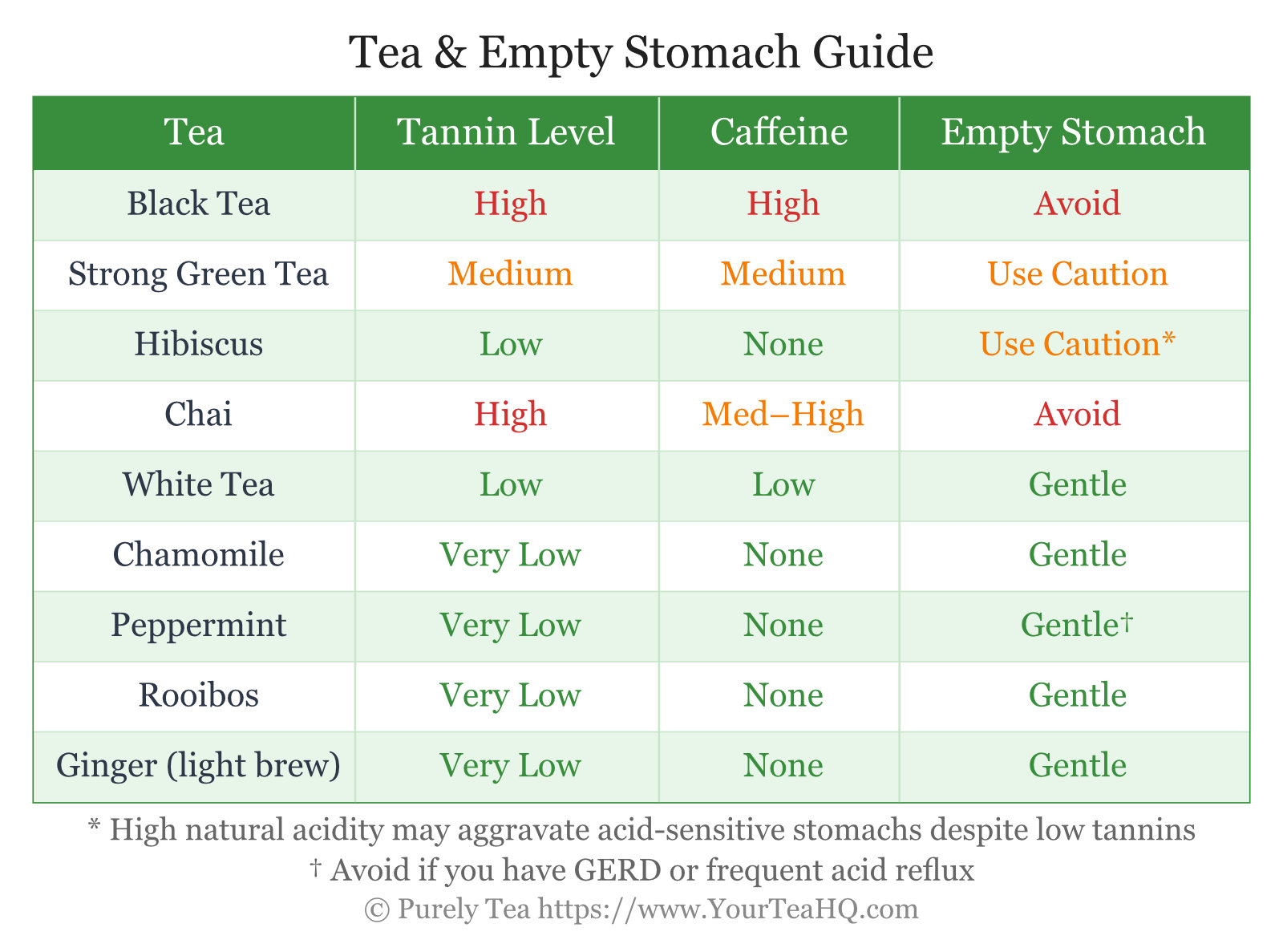
Black tea sits at the top of this list. It carries the highest tannin concentration among commonly consumed teas and delivers anywhere from 40 to 90 mg of caffeine per 8-ounce cup depending on how it is brewed and for how long. That combination — high tannins plus meaningful caffeine — means the gastric acid response arrives quickly and stays elevated.
Strongly brewed green tea is a close second. While green tea’s catechins are structurally different from the theaflavins and thearubigins in black tea, they are still effective at stimulating acid production. The caffeine in green tea contributes too. People who experience stomach discomfort from green tea often find those reactions are significantly worse before meals than after.
Hibiscus tea deserves a mention here even though it contains no caffeine and relatively few tannins, because its natural pH is very low — it is one of the more acidic herbal teas available. For anyone whose stomach is already producing acid without a food buffer, hibiscus can add to the problem rather than ease it.
Strong chai — particularly commercially prepared versions — layers black tea tannins and caffeine with stimulating spice compounds from black pepper and ginger. On an empty stomach, that combination tends to feel harsh within the first few sips.
The Teas That Are Gentler Before You Eat
If you want a tea that sits comfortably before breakfast, the shortlist shares three qualities: low tannin load, minimal caffeine, and ideally some degree of soothing action on the digestive tract.
Rooibos is the most straightforward choice. It is naturally caffeine-free and considerably lower in tannins than any true tea — its composition documented clearly in the research on its antioxidant profile (Hong et al., 2014). There are no parietal cells being triggered, no tannin-protein binding at the gastric mucosa. If you want something warm to hold before breakfast, rooibos is arguably the most forgiving option, and what makes rooibos genuinely worth reaching for extends well beyond its stomach-friendly composition.
White tea is another gentle option. Its tannin content is lower than both green and black tea because the leaves undergo minimal processing, and caffeine typically sits at the lower end of the range for true teas — around 15 to 30 mg per cup. It will not make much of a demand on an unprepared stomach.
Chamomile is reliable for a different reason. It contains no caffeine, low tannins, and the flavonoid apigenin has been studied for its antispasmodic effects on GI smooth muscle. Chamomile’s broader calming effects on digestion make it a natural fit for anyone whose stomach tends to be reactive in the mornings.
Peppermint deserves a measured mention. It is caffeine-free, and menthol relaxes the smooth muscle of the GI tract. For people without acid reflux, that can ease morning digestive discomfort — the mechanism behind why peppermint tea settles bloating and gut unease applies just as well to an irritated empty stomach. The caveat: if you have GERD or frequent reflux, peppermint can worsen it by relaxing the lower esophageal sphincter, so it is worth knowing your own pattern first.
Lightly brewed ginger tea is worth considering for a specific reason. Gingerols — the active compounds in ginger — work partly through 5-HT3 receptor activity to reduce nausea (Dai et al., 2022), which means a gentle ginger brew may actually work in your favour if your concern is morning queasiness. The word “lightly” matters here. The way ginger brews differently from most other teas means a five-minute simmer and a two-minute steep produce very different cups. For an empty stomach, keep it brief and mild. In that form, it is a strong contender for anyone who tends toward morning queasiness.
Ashley’s Note: My Morning Workaround
It took me an embarrassingly long time to connect my morning nausea to my habit of going straight for a strong black tea before eating anything. I’d always assumed I was just not a morning person. Once I started keeping a chamomile or rooibos by the kettle and waiting for even a small snack before reaching for black tea, the whole problem disappeared. It sounds almost too simple, but sometimes that’s exactly what it is.
Why Timing Matters More Than You Think
The timing of your first cup adds a layer that does not get much attention. Cortisol — the hormone that naturally peaks around 30 to 45 minutes after waking — is already providing a degree of alertness in the early morning. Layering caffeine on top of a natural cortisol spike means the stimulation is redundant, and any side effects of caffeine, including increased gastric acid production, are operating in an already-activated system. The relationship between morning cortisol and your tea timing is worth understanding if you drink green or black tea regularly. Waiting until at least 45 minutes after waking — and having something light to eat first — lets both the cortisol curve and the empty-stomach conditions settle before tea enters the picture.
Practical Ways to Make Your Morning Tea Gentler
The most effective change is also the simplest: eat something first. Even a small amount — a few crackers, a slice of bread, a handful of nuts — is enough to coat the stomach lining and buffer the tannin and acid response meaningfully. The quantity matters less than the act of eating at all.
If you genuinely cannot eat before your first cup, the tea itself needs adjustment. Cold-brewed tea extracts significantly fewer tannins than hot-brewed tea because tannins are more soluble at higher temperatures. A cold-brewed black or green tea will still deliver caffeine, but the tannin load and the corresponding gastric irritation will be lower. Shorter steep times have a similar effect — a two-minute steep extracts far less tannin than a five-minute one.
Adding a splash of milk is not just a cultural habit. The proteins in dairy bind to tannins before they reach the stomach lining, which is precisely why the research showed that plain tea without milk produced a significantly more aggressive gastric acid response than tea with milk (Dubey et al., 1984). Plant milks vary in their effectiveness here — oat milk and rice milk are primarily carbohydrate and buffer less well. Soy milk and pea-protein milks contain enough protein to provide a useful effect.
If you are skipping breakfast as part of an intentional fasting protocol rather than just running behind schedule, the considerations around which teas fit your fasting window are a bit different from the everyday empty-stomach scenario covered here.
When the Stakes Are Higher
For most people, asking whether it is bad to drink tea on an empty stomach leads to a fairly reassuring answer — it is a minor comfort issue and the adjustments above will solve it. For some, however, the picture is more serious.
People with gastritis, peptic ulcers, or GERD are better off avoiding tannin-heavy caffeinated teas before eating. These conditions involve already-compromised gastric mucosa or impaired lower esophageal function, and the combined acid and tannin stimulation from strong tea without food can trigger or worsen symptoms meaningfully.
Iron absorption is a separate but real concern. Tannins in tea form insoluble complexes with non-heme iron, inhibiting its absorption from plant-based food sources (Disler et al., 1975). This is a documented issue for people who follow plant-forward diets or who already have low iron levels — the full picture of how tea’s tannins interact with the body’s iron uptake is worth reading if this applies to you. Drinking tea on an empty stomach first thing in the morning, right before or after iron-rich plant foods, maximizes this interference. Separating tea and iron-containing meals by at least an hour is a simple and effective workaround.
The Bottom Line
The morning tea ritual does not need to go anywhere. The difference between a cup that leaves you feeling settled and one that leaves you queasy usually comes down to three things: what you drink, how you brew it, and whether there is anything else in your stomach at the time. A gentle swap for rooibos or chamomile on mornings when breakfast is not happening, a shorter steep on the days when black tea is non-negotiable, or even a few crackers before the kettle boils — small adjustments, and the tea stays.
Disclaimer: The information on Purely Tea is for educational purposes only and is not intended as medical advice. Always consult with a healthcare professional before making changes to your diet, especially if you have underlying health conditions.
References
- de Jesus, N. Z. T., de Souza Falcão, H., Gomes, I. F., de Almeida Leite, T. J., de Morais Lima, G. R., Barbosa-Filho, J. M., Tavares, J. F., da Silva, M. S., de Athayde-Filho, P. F., & Batista, L. M. (2012). Tannins, peptic ulcers and related mechanisms. International Journal of Molecular Sciences, 13(3), 3203–3228.
- Liszt, K. I., Ley, J. P., Lieder, B., Behrens, M., Stöger, V., Reiner, A., Hochkogler, C. M., Köck, E., Marchiori, A., Hans, J., Widder, S., Krammer, G., Sanger, G. J., Somoza, M. M., Meyerhof, W., & Somoza, V. (2017). Caffeine induces gastric acid secretion via bitter taste signaling in gastric parietal cells. Proceedings of the National Academy of Sciences, 114(30), E6260–E6269.
- Disler, P. B., Lynch, S. R., Charlton, R. W., Torrance, J. D., Bothwell, T. H., Walker, R. B., & Mayet, F. (1975). The effect of tea on iron absorption. Gut, 16(3), 193–200.
- Dai, Y., Zhao, Y., & Nie, K. (2022). The antiemetic mechanisms of gingerols against chemotherapy-induced nausea and vomiting. Evidence-Based Complementary and Alternative Medicine, 2022, 1753430.
- Hong, I.-S., Lee, H.-Y., & Kim, H.-P. (2014). Anti-oxidative effects of rooibos tea (Aspalathus linearis) on immobilization-induced oxidative stress in rat brain. PLOS ONE, 9(1), e87061.
- Dubey, P., Sundram, K. R., & Nundy, S. (1984). Effect of tea on gastric acid secretion. Digestive Diseases and Sciences, 29(3), 202–206.
{
“@context”: “https://schema.org”,
“@type”: “FAQPage”,
“mainEntity”: [
{
“@type”: “Question”,
“name”: “Is it bad to drink tea on an empty stomach?”,
“acceptedAnswer”: {
“@type”: “Answer”,
“text”: “For most people, drinking tea on an empty stomach causes mild discomfort like nausea or a burning sensation because tannins and caffeine stimulate gastric acid with nothing to buffer it. It is not dangerous for healthy individuals, but people with gastritis, GERD, or peptic ulcers should be more cautious.”
}
},
{
“@type”: “Question”,
“name”: “What is the best tea to drink on an empty stomach?”,
“acceptedAnswer”: {
“@type”: “Answer”,
“text”: “Rooibos is the gentlest option — it is naturally caffeine-free and very low in tannins. Chamomile, white tea, and lightly brewed ginger tea are also good choices. Avoid strong black tea, green tea, and hibiscus on an empty stomach if you are prone to nausea or acid sensitivity.”
}
},
{
“@type”: “Question”,
“name”: “Why does tea make me feel nauseous in the morning?”,
“acceptedAnswer”: {
“@type”: “Answer”,
“text”: “The nausea is usually caused by tannins irritating the gastric mucosa and caffeine stimulating excess acid production, with no food present to buffer either effect. Stronger brews and higher-tannin teas like black tea worsen the response. Eating something small first or switching to a lower-tannin tea typically resolves it.”
}
},
{
“@type”: “Question”,
“name”: “Does adding milk to tea help with empty stomach discomfort?”,
“acceptedAnswer”: {
“@type”: “Answer”,
“text”: “Yes. The proteins in milk bind to tannins before they reach the stomach lining, reducing gastric irritation. Research found plain tea without milk produced a significantly higher acid response than tea with milk. Soy and pea-protein milks offer a similar benefit; oat and rice milks are lower in protein and buffer less effectively.”
}
},
{
“@type”: “Question”,
“name”: “Can I drink green tea before breakfast?”,
“acceptedAnswer”: {
“@type”: “Answer”,
“text”: “Green tea can cause nausea on an empty stomach due to its catechin and caffeine content. If you prefer green tea in the morning, keep the steep short — around 90 seconds — use water below boiling, and pair it with at least a small snack. Waiting until mid-morning rather than drinking immediately after waking also helps.”
}
},
{
“@type”: “Question”,
“name”: “Does drinking tea before breakfast affect iron absorption?”,
“acceptedAnswer”: {
“@type”: “Answer”,
“text”: “Yes. Tannins in tea form insoluble complexes with non-heme iron, inhibiting its absorption from plant-based foods. Drinking tea on an empty stomach right before or after iron-rich plant foods maximizes this interference. Separating tea and iron-containing meals by at least one hour significantly reduces the impact.”
}
},
{
“@type”: “Question”,
“name”: “Is rooibos tea safe to drink before eating?”,
“acceptedAnswer”: {
“@type”: “Answer”,
“text”: “Rooibos is one of the safest teas to drink before eating. It contains no caffeine and significantly lower tannin levels than black, green, or oolong tea, meaning it does not stimulate gastric acid or irritate the stomach lining the way true teas can. It is a reliable morning option for sensitive stomachs.”
}
}
]
}
