
Your Organic Herbal Tea Has a Passport — Here’s Why the Country of Origin Changes Everything

I was at a trade show, talking to a supplier, when I picked up a certified organic chamomile blend and asked where it came from. “Egypt, India, Morocco — blended in Germany,” she said. A German organic seal sat right on the front of the box. That was the moment I understood that organic herbal tea comes with a passport, and the passport matters as much as the stamp it carries. The seal tells you what inputs were avoided. Where the tea was actually grown tells you how much that means.
The Label Tells You What. The Country Tells You How.
When a box carries an organic certification, it means the farm documented that it avoided synthetic pesticides, herbicides, and fertilizers during production — and that an auditor visited the farm to verify those claims. What it does not tell you is how often that auditor visits, how independent they are from the certifier, or what the soil history of that land looked like before certification began.
Organic certification is an input-based standard, not an outcome-based one. No regulatory framework requires finished organic herbal tea to be tested for residues before it reaches consumers. The certification confirms the process, not the result. That gap is where country of origin becomes the most useful piece of information a label can offer.
Two farms can hold identical EU Organic or USDA certificates and operate under dramatically different real-world conditions — different audit frequency, different certifier independence, different soil histories, and different surrounding agricultural environments. The certification tells you what was claimed. The country, and often the specific region within that country, tells you how much that claim is likely to mean in practice.
Sandy’s Science Corner: Two Contamination Routes Explained
Not all contamination enters a plant the same way. Foliar spray residues — pesticides applied directly to leaves, flowers, and petals — are addressed by organic certification, which prohibits synthetic inputs entirely. Soil contamination, including heavy metals like cadmium and lead from industrial activity or long-term conventional farming, is absorbed through the root system. Organic certification addresses the first problem. It does nothing to remediate the second, which is why origin matters differently depending on whether you are drinking a chamomile flower or a ginger root (European Food Safety Authority, 2022).
Egypt: The World’s Chamomile and Hibiscus Powerhouse
Most of the chamomile and hibiscus that ends up in European and North American supermarket blends originates in Egypt. The country is the dominant global exporter of both herbs, and the scale of production is significant — the Nile Delta and Upper Egypt growing regions supply much of what carries an organic label in finished products worldwide.
Egyptian farms do hold internationally recognised certifications, primarily through Ecocert and IMO, both of which operate inspection programmes in the country. The concern is not that certification is absent, but that audit frequency and certifier independence in Egyptian agricultural contexts have historically been less consistent than in EU domestic farming, where nationally accredited certification bodies operate under European Commission supervision.
Monitoring data compiled by European food safety authorities has flagged organophosphate compound residues — a class of pesticide historically used in Egyptian agriculture — in dried chamomile from North African origins at rates higher than comparable EU-grown samples (European Food Safety Authority, 2022). For a flower with a high surface-to-mass ratio, where every part of the bloom is in direct contact with whatever was sprayed during the growing season, that distinction is not a minor one. If you drink chamomile regularly for its sleep-supporting and digestive character, the origin of those flowers is worth a second look.
What to look for: EU-certified Egyptian-origin chamomile specifically, where import testing requirements add a verification layer that domestically certified-only product does not carry.
India: Ginger, Tulsi, and the Traceability Question
India is the world’s largest ginger producer and a primary source of tulsi, lemongrass, and cardamom for the global herbal tea market. India’s domestic organic certification framework — the National Programme for Organic Production (NPOP) — is government-run and internationally recognised. India’s organic exports to the EU and United States operate under mutual recognition agreements, which is a genuine positive for traceability at the national level (United States Department of Agriculture, 2023).
The nuance sits at the supply chain level. Much of India’s certified organic herb production comes through small-farm cooperatives, where the path from individual plot to export facility involves several intermediary steps. Each step introduces points where commingling of certified and non-certified lots can occur — not necessarily through deliberate fraud, but through the practical complexity of aggregating small certified harvests across many growers.
For ginger root specifically, the growing method introduces a distinct consideration: because it develops underground, it absorbs from the soil directly rather than from foliar sprays. Regions in Kerala and Meghalaya, where rainfall is high and drainage patterns vary, affect how soil-applied inputs move through the root system (Mashhadi et al., 2013). Knowing not just that ginger is certified organic, but where in India it was grown, adds meaningful context.
The standout exception is Sikkim, India’s first fully organic state, where mandatory organic farming applies statewide and enforcement extends beyond NPOP requirements. Single-origin Sikkim-sourced herbs represent one of the cleaner options for root-based ingredients regardless of what the broader national certification framework looks like on paper.
China: Where Certification Meets Soil History
China is a significant producer of licorice root and ginger for the global herbal market, and its share of the supply chain for common tea blend ingredients is larger than most labels reveal. China operates its own organic certification framework through the OFDC (Organic Food Development Centre), and EU import authorities have periodically identified inconsistencies in independent auditing of Chinese organic claims (European Food Safety Authority, 2022).
The more specific concern for Chinese-origin roots goes beyond pesticide application. Soil contamination from heavy metals — cadmium, lead, and arsenic from industrial activity and legacy agricultural practices — is a documented issue in certain Chinese growing regions. Unlike synthetic pesticides, which organic certification directly restricts, heavy metals are not applied inputs. They persist in the soil regardless of current farming practices, and root systems absorb them into the plant material itself.
This is the scenario where organic certification does not solve the problem it appears to address. A licorice root grown on certified organic land in a region with documented soil contamination can carry those metals into a finished cup regardless of what the label says. For Chinese-origin root herbs specifically, EU-certified imports carry an additional layer of assurance because EU import testing standards are more stringent than domestic Chinese certification frameworks alone.
South Africa: The Rooibos Exception
Rooibos is one of the rare cases in the herbal tea world where geography and quality are essentially inseparable. The plant grows only in the Cederberg region of South Africa’s Western Cape — this is not a marketing claim but a biological reality, as rooibos cannot be successfully cultivated outside this specific mountain fynbos environment. That constraint makes origin verification straightforward and makes the supply chain unusually transparent compared to herbs sourced across multiple regions and seasons.
South Africa’s agricultural export standards are strong, and the Rooibos Council provides supply chain traceability at a level uncommon in most other herb-growing industries. Conventional rooibos from reputable producers consistently performs well in residue monitoring, often outperforming conventional herbs from regions with significantly less regulatory oversight (Joubert et al., 2008).
This is the one herb where experienced buyers are genuinely flexible on organic certification. Fair-trade and Rainforest Alliance certifications arguably carry more practical meaning for rooibos than the organic label, given the community and biodiversity dimensions specific to Cederberg farming. What to prioritise on a rooibos label is a Cederberg origin designation over a generic “product of South Africa” claim.
Bulgaria and Eastern Europe: The Quiet Benchmark
Bulgaria is one of the world’s largest lavender and rose producers, and a significant source of lemon balm, nettle, and elderflower. As an EU member state, Bulgarian farms operate under EU Organic Regulation — meaning national accreditation bodies audit farms under European Commission supervision, not through self-reporting or domestically independent certification alone.
That distinction has real practical weight. EU-domestic organic certification involves a different standard of enforcement rigour than most non-EU origin certifications, because the framework extends to national competent authorities and EC oversight, not just to individual certifying organisations. For lavender, grown in Bulgaria’s Rose Valley alongside centuries of rose cultivation, this combination of EU enforcement and established regional agricultural tradition makes Bulgarian-origin herbs among the most straightforward sourcing decisions in the category.
Romania and Poland are growing as sources for the same herbs under the same regulatory framework, offering accessible, well-enforced alternatives as Bulgarian export prices continue rising with global demand.
The USA and Pacific Northwest: Where Peppermint Belongs
The Willamette Valley in Oregon and parts of Washington state produce the majority of the world’s commercial peppermint. USDA NOP is the most prescriptive certification framework available in terms of documented input requirements and audit trail, and US-grown certified organic peppermint represents the clearest case of certification and origin aligning without qualification (United States Department of Agriculture, 2023).
The reason origin matters specifically for peppermint is that the herb’s therapeutic and flavour character comes from its essential oil profile — the same fat-soluble compounds responsible for its well-documented effects on digestion and cooling (McKay & Blumberg, 2006). Fat-soluble pesticide residues bind preferentially to those same essential oils, which means compromising the herb’s purity and compromising its character happen simultaneously. Reaching for peppermint because of what it reliably delivers in a well-brewed cup means sourcing it from a region where both the certification and the enforcement behind it are clear.
Ashley’s Note: Two Questions I Always Ask
Before buying any organic herbal tea, I ask two things: where was this grown, and who certified it there? If a brand can answer both specifically — not “various origins,” not just a generic seal — I trust it. The brands that know exactly which farm their chamomile came from are almost always the ones who care what arrives in the cup. It takes thirty seconds to check, and it changes how you shop.
How to Find Country of Origin on a Tea Package
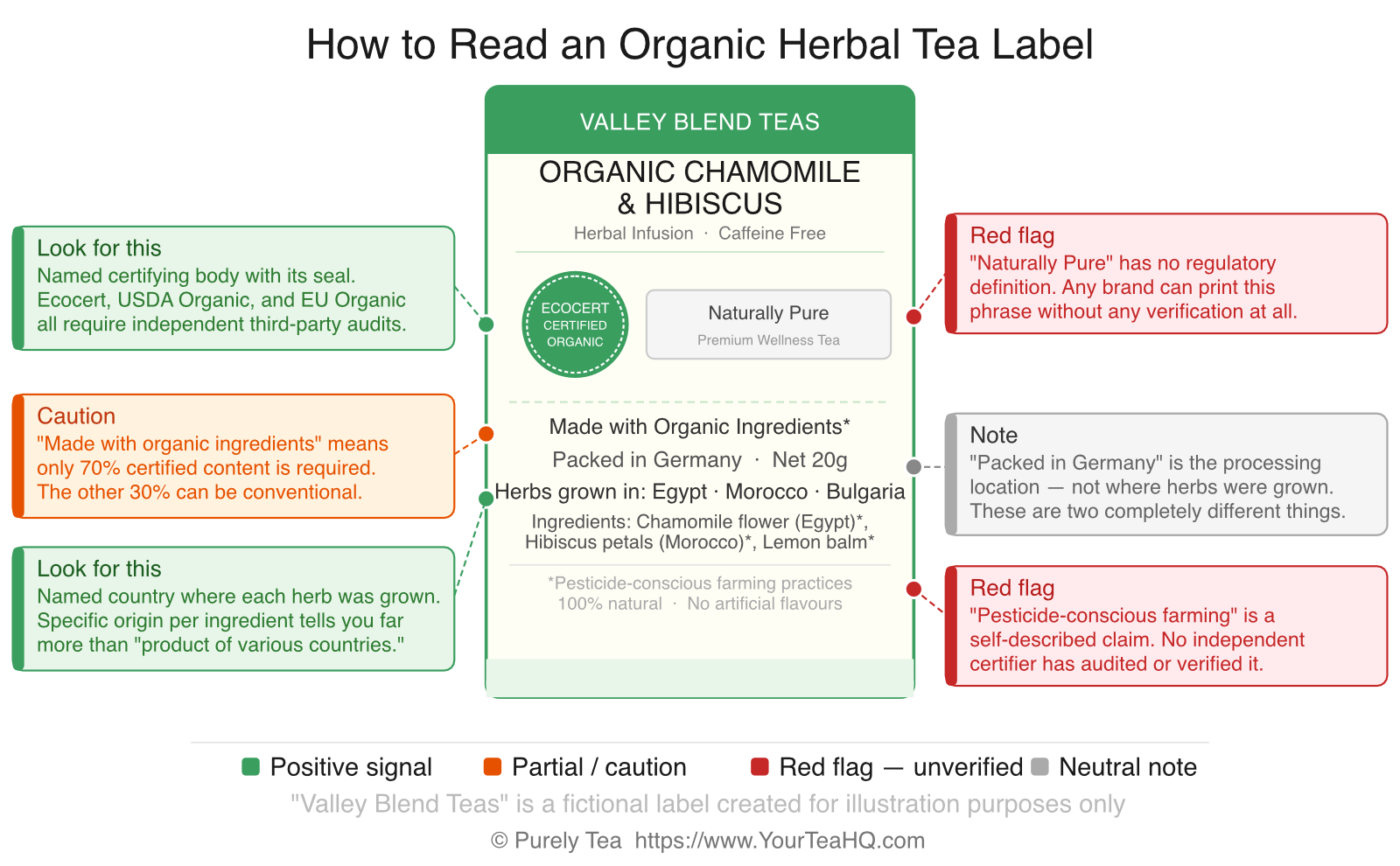
This information is legally required on packaging in both the EU and US, but it is frequently listed as country of final processing rather than country of growth. “Packed in Germany” or “blended in the UK” means the packaging facility is in that country — not that the herbs were grown there. What you are looking for is a “grown in” or “origin:” notation, which often appears in small print near the ingredients list or on the side panel.
Multi-herb blends present a particular challenge. Ingredients are listed by weight but origin is commonly aggregated as “product of various countries” — a designation that tells you almost nothing useful. The practical workaround is to choose single-herb or clearly single-origin products where possible, or to buy from brands that publish sourcing information by ingredient on their website. Whether loose leaf or bagged, what ends up in your cup begins with decisions made long before the kettle goes on — and what the bag itself is made from is a related but separate question worth considering.
Asking whether is organic tea worth it becomes significantly easier to answer when you also know where the tea was grown. A certified organic blend of undisclosed origin is harder to evaluate than a single-herb product with a named growing region, a named certifier, and a traceable supply chain. When those three elements align, the answer to is organic tea worth it is almost always yes — not because the label guarantees a specific outcome, but because the combination of rigorous certification and transparent origin removes the variables that make the label uncertain in the first place.
Conclusion
The organic label earned its meaning in a simpler supply chain than the one herbal tea actually travels. Knowing where your chamomile was grown, or your ginger root, or your lavender, takes you past the seal and into the actual soil — and that is where the real answer lives. It is not a complicated ask. Thirty seconds of label reading is all it takes to turn every cup into a more intentional one.
References
- European Food Safety Authority. (2022). The 2020 European Union report on pesticide residues in food. EFSA Journal, 20(3), 7215.
- Hopkins, A. L., Lamm, M. G., Funk, J. L., & Ritenbaugh, C. (2013). Hibiscus sabdariffa L. in the treatment of hypertension and hyperlipidemia: A comprehensive review of animal and human studies. Fitoterapia, 85, 84-94.
- Joubert, E., Gelderblom, W. C. A., Louw, A., & de Beer, D. (2008). South African herbal teas: Aspalathus linearis, Cyclopia spp. and Athrixia phylicoides — A review. Journal of Ethnopharmacology, 119(3), 376-412.
- Mashhadi, N. S., Ghiasvand, R., Askari, G., Hariri, M., Darvishi, L., & Asgari Jafarabadi, M. (2013). Anti-oxidative and anti-inflammatory effects of ginger in health and physical activity: Review of current evidence. International Journal of Preventive Medicine, 4(Suppl 1), S36-S42.
- McKay, D. L., & Blumberg, J. B. (2006). A review of the bioactivity and potential health benefits of peppermint tea (Mentha piperita L.). Phytotherapy Research, 20(8), 619-633.
- Srivastava, J. K., Shankar, E., & Gupta, S. (2010). Chamomile: A herbal medicine of the past with bright future. Molecular Medicine Reports, 3(6), 895-901.
- United States Department of Agriculture. (2023). National Organic Program. Agricultural Marketing Service.
