
Tea and Longevity: What the World’s Oldest People Have in Common
There’s a pattern that keeps showing up when researchers study the world’s oldest people: tea. Not supplements. Not strict meal plans. Just tea, brewed simply, consumed daily for decades. The science connecting tea and longevity has grown considerably in recent years, including a large study tracking nearly 14,000 people that found regular drinkers appear to age more slowly at a biological level. I’ve been following this research closely, and what it reveals might surprise you.
What Researchers Noticed About the World’s Longest-Lived Populations
Researchers studying regions with unusually high concentrations of people who live past 100 have documented strikingly similar daily habits across cultures that share almost nothing else. Whether the population is in Okinawa, Japan; Sardinia, Italy; Ikaria, Greece; Nicoya, Costa Rica; or the Seventh-day Adventist community in Loma Linda, California, certain lifestyle threads appear again and again: strong social bonds, low chronic stress, plant-forward diets, natural daily movement, and a clear sense of purpose (Buettner, 2025). Tea drinking doesn’t show up in every population on that list, but it figures prominently in enough of them to draw serious scientific attention.
In Okinawa, green tea is a constant presence. Residents traditionally brew large quantities and sip throughout the day rather than consuming a single rushed cup. In Ikaria, Greece, wild herbal infusions made from locally gathered plants have been part of daily life across generations. Even in populations where tea doesn’t dominate the beverage culture, polyphenol-rich plant drinks appear consistently (Mishra, 2009). That pattern alone doesn’t prove tea drives longevity. What makes the research interesting is what happens when scientists design studies specifically to find out. The documented range of benefits associated with regular tea consumption has grown substantially in the past decade, and longevity research now sits near the top of that conversation.
The Large-Scale Study That Changed the Conversation
In 2023, a research team from Sichuan University published findings in The Lancet Regional Health — Western Pacific that drew wide attention. The study followed nearly 14,000 participants across two separate cohorts: one drawn from a diverse Chinese population ranging in age from 30 to 79, and one from the UK Biobank, covering participants aged 37 to 73. Researchers tracked tea consumption alongside a set of clinical biomarkers used to estimate biological age — a measure of how quickly the body is actually aging, independent of the number of years someone has been alive (Xiang et al., 2023).
The results showed that people who drank tea regularly experienced slower biological age acceleration compared to non-drinkers. That association held across both cohorts, which matters because it persisted across different ethnicities, cultural contexts, and different primary tea types consumed. When a finding is consistent across two independently selected populations, it carries more weight than a single-population result. The researchers were careful to note that this was an observational study — it demonstrates a relationship between tea consumption and slower biological aging, not a direct cause-and-effect mechanism. Tea drinkers may share other health-supportive habits that contribute to the picture. But the consistency of the finding across such a large and diverse group is difficult to dismiss.
Sandy’s Science Corner: Biological Age vs. Your Birth Year
Chronological age just counts years. Biological age measures how your body is actually functioning — using blood markers like glucose, albumin, and blood pressure to produce a score that can run younger or older than your calendar age. The Klemera-Doubal method used in the Xiang et al. (2023) study is a validated approach to this calculation. Two people who are both 60 chronologically could have biological ages of 53 and 67. Tea’s association with slower biological age acceleration suggests the gap between the two types of age may narrow with a consistent tea habit.
What Tea Actually Does Inside Your Body
The biological effects of tea on aging don’t come from a single compound. They come from a group of plant chemicals — predominantly polyphenols — that appear to work across multiple body systems simultaneously. The most studied of these in the context of aging are catechins, particularly a compound called epigallocatechin-3-gallate, or EGCG, which is found in especially high concentrations in unoxidized green tea.
At the cellular level, EGCG has been shown in multiple studies to support DNA repair mechanisms, reduce oxidative stress, and help protect telomeres — the protective end-caps on chromosomes that shorten naturally with each cell division. Shorter telomeres are associated with faster cellular aging and elevated risk of age-related disease. A 2023 study that followed 1,952 participants over six years found that people who drank at least one cup of green tea daily showed significantly less telomere shortening than non-consumers (Sohn et al., 2023). A 2025 narrative review in the journal Aging and Disease synthesized evidence across in vitro, animal, and human studies to map out how green tea polyphenols appear to address multiple hallmarks of aging simultaneously — including chronic inflammation, declining mitochondrial function, and impaired cellular cleanup processes (Yilmaz, 2025). Chronic low-grade inflammation is a root driver of most age-related diseases, which helps explain why tea’s anti-inflammatory action appears in research across several different health domains, not just aging specifically.
Tea also contains L-theanine, an amino acid that doesn’t appear in meaningful quantities in any other common food or beverage. L-theanine appears to work in concert with tea’s polyphenols rather than in isolation — another reason why researchers studying tea and longevity focus on whole-leaf consumption rather than isolated supplements. The synergy between compounds in the whole plant matters in ways that standardized extracts may not capture.
The Green Tea Longevity Research
Among all tea types, green tea carries the deepest research foundation on aging, largely because Okinawa — one of the most studied long-lived populations in the world — has traditionally consumed it in quantity across generations. Okinawan tea culture isn’t particularly ceremonial. It’s casual, constant, and has been going on for a very long time. That kind of decades-long daily exposure is genuinely difficult to replicate in a short clinical trial, which is why population-based research from regions with established tea traditions gives researchers a useful window into what consistent consumption actually does over time (Mishra, 2009).
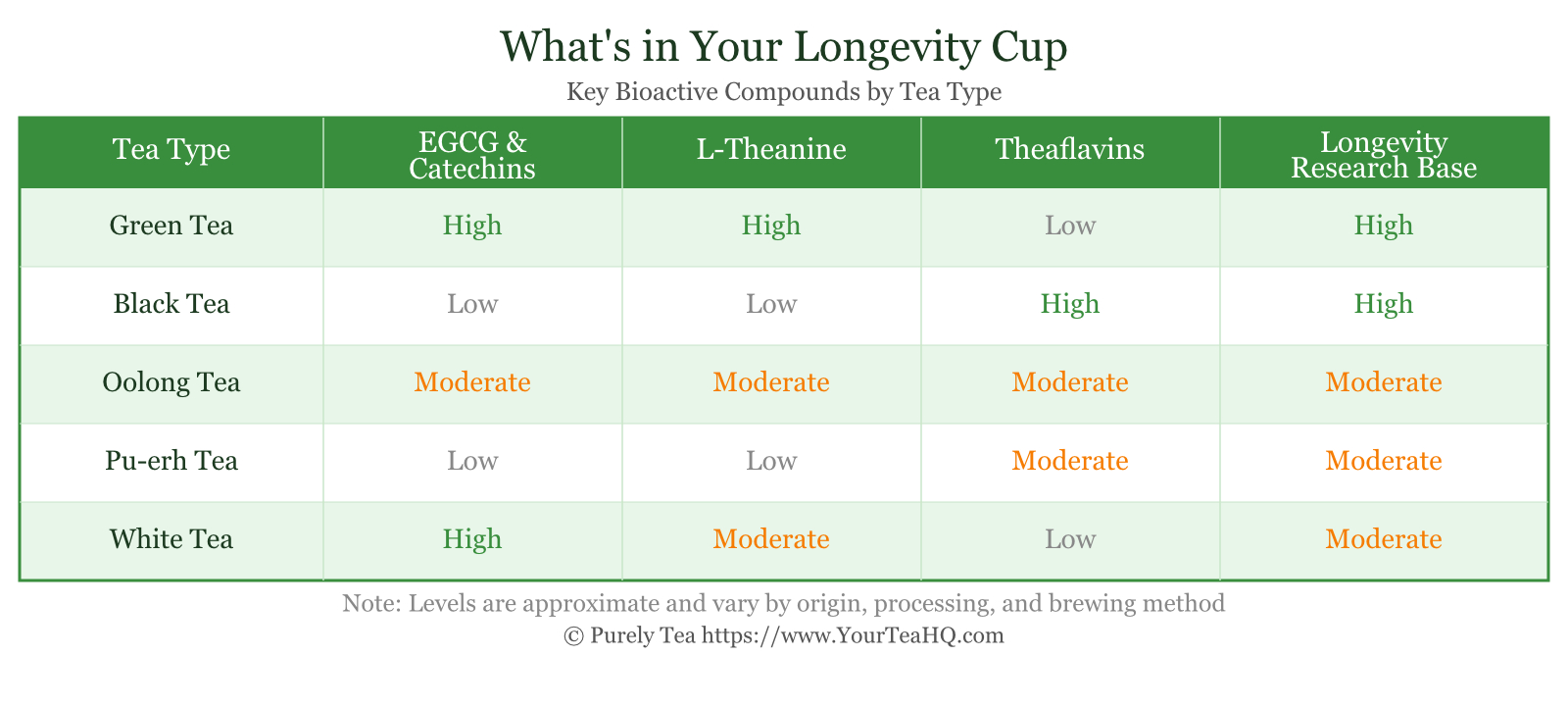
Green tea longevity research extends well beyond Okinawa. The Xiang et al. (2023) cohort study found consistent biological aging associations in both Chinese and UK populations, suggesting the effect isn’t confined to one ethnic group or dietary pattern. The underlying mechanism connects to the catechin profile, which is particularly well-preserved in unoxidized leaves, giving green tea a higher concentration of EGCG than black or oolong varieties. This is also one reason why steeping temperature matters in practice — water above approximately 80°C begins to degrade some of these compounds before they reach your cup. Green tea longevity benefits appear tied to what actually makes it into the cup, not just what exists in the dry leaf. From a broader cardiovascular standpoint, regular green tea consumption has also been examined in relation to blood pressure regulation, which is one of the more significant factors in long-term cardiovascular health — an area where green tea’s catechin pathway appears particularly active.
Black Tea, Longevity, and the Population Data
Green tea tends to dominate the longevity headlines, but the relationship between black tea and longevity has its own substantial evidence base. A 2024 meta-analysis pooling data from 38 prospective cohort studies — representing nearly two million participants — found that tea drinkers had a measurably lower risk of all-cause mortality, with the strongest associations seen at around two cups per day. This research largely captured populations where black tea was the dominant type consumed, making it one of the most directly relevant analyses for understanding black tea and longevity in Western contexts (Kim & Je, 2024). The UK Biobank study, which followed nearly 500,000 people over multiple years, found similarly reduced mortality risk among regular tea drinkers — and that population drinks predominantly black tea.
Black tea contains different polyphenols than green tea — primarily theaflavins and thearubigins, which form during the oxidation process. These compounds carry their own antioxidant and anti-inflammatory activity, even though they’re chemically distinct from EGCG. The cardiovascular effects appear especially significant; theaflavins have been studied for roles in cholesterol regulation and arterial function, both of which connect directly to longevity outcomes. For those curious about aged and fermented tea varieties, pu-erh occupies an interesting place in the longevity picture — consumed widely across Chinese regions with notably high proportions of long-lived people — though its specific research base is less developed than that of green or black tea.
Ashley’s Note: The Shift That Actually Stuck
After reading this research, the change I made wasn’t switching tea types — it was slowing down. I used to drink whatever was fastest to make and gulp it while doing something else. Now I treat the first cup of the day as something that actually has my full attention. That unhurried quality is one of the most consistent things I notice about how tea is consumed in long-lived populations. Not as a ritual for ritual’s sake. Just not rushed.
It’s Not Just the Tea
Any honest account of tea and longevity research has to acknowledge something important: people in the world’s longest-lived populations aren’t just drinking tea. They’re typically also eating mostly plants, moving gently throughout the day, maintaining strong social connections, and living without the persistent psychological stress that characterizes modern urban life (Buettner, 2025). These factors interact with each other — and with tea consumption — in ways that are genuinely difficult to separate.
What this means practically is that tea should be understood as one component of a low-inflammation lifestyle, not a single intervention that offsets everything else. The research doesn’t support the idea that drinking green tea while eating a heavily processed diet, sleeping poorly, and living under chronic stress will produce centenarian outcomes. It does suggest that for people already living in a broadly health-supportive way, a daily tea habit contributes meaningfully to how the body ages over time. The compounding effect of consistent, low-level polyphenol exposure across years and decades seems to be one of the more important aspects of the relationship — which is why the populations researchers study are notable not for large quantities of tea but for the uninterrupted duration of the habit across a lifetime.
Tea’s broader health picture includes more than longevity markers alone. The same anti-inflammatory polyphenols linked to aging research also appear in studies on liver function and metabolic health — effects that are connected to the longevity picture rather than separate from it. Each of these domains is a thread in the same underlying mechanism.
How Much, How Often, and Which Kind
The research doesn’t point to one specific tea type as the longevity winner, nor does it require large daily quantities. Most of the cohort and meta-analysis data cluster around two to three cups per day as the range where consistent associations appear. Drinking more than that doesn’t seem to produce additional gains — the dose-response curve flattens out fairly early, and the greatest measured risk reductions appear around the two-cup-per-day mark (Kim & Je, 2024).
Green tea carries the deepest anti-aging research base and the most direct connection to the biological mechanisms studied. Black tea is strongly supported by population-level mortality data, particularly in studies conducted in Western Europe and East Asia where it is the dominant variety consumed. Herbal infusions — especially those incorporating anti-inflammatory ingredients like turmeric — don’t contain the same Camellia sinensis polyphenol profile, but they contribute to the broader low-inflammation picture that tea-drinking populations tend to maintain. White tea is the least processed form of Camellia sinensis and retains a polyphenol profile similar to green tea with a particularly delicate flavor, which makes it easier for many people to drink consistently without added milk or sugar.
What the research consistently supports, regardless of tea type, is the value of consistency over optimization. Drinking a type of tea you genuinely like, daily, across years, appears to matter more than identifying the most potent variety and forcing yourself to drink it. The habit sustains the benefit. That’s what the world’s longest-lived tea drinkers seem to have understood long before the studies were ever run.
A Simple Habit With Long-Term Returns
You don’t need to follow a strict centenarian diet or move somewhere remote to adopt the one habit that keeps appearing across the world’s longest-lived populations. The science of tea and longevity points not to a dramatic intervention but to something modest and repeatable: a cup or two a day, every day, without the rush. I find that oddly encouraging. The oldest tea drinkers in the world didn’t optimize their way to 100. They just never stopped drinking tea.
Disclaimer: The information on Purely Tea is for educational purposes only and is not intended as medical advice. Always consult with a healthcare professional before making changes to your diet, especially if you have underlying health conditions.
References
- Xiang, Y., Xu, H., Chen, H., Tang, D., Huang, Z., Zhang, Y., Wang, Z., Wang, Z., Yangla, Han, M., Yin, J., Xiao, X., & Zhao, X. (2023). Tea consumption and attenuation of biological aging: a longitudinal analysis from two cohort studies. Lancet Regional Health – Western Pacific, 42, 100955.
- Sohn, I., Shin, C., & Baik, I. (2023). Associations of green tea, coffee, and soft drink consumption with longitudinal changes in leukocyte telomere length. Scientific Reports, 13, 492.
- Buettner, D. (2025). Lessons from the Blue Zones: There is no silver bullet (or magic pill) for a long, healthy life. American Journal of Lifestyle Medicine.
- Yilmaz, Y. (2025). Green tea mitigates the hallmarks of aging and age-related multisystem deterioration. Aging and Disease, 17(2), 712–730.
- Mishra, B. N. (2009). Secret of eternal youth; teaching from the centenarian hot spots (“Blue Zones”). Indian Journal of Community Medicine, 34(4), 273–275.
- Kim, Y., & Je, Y. (2024). Tea consumption and risk of all-cause, cardiovascular disease, and cancer mortality: a meta-analysis of thirty-eight prospective cohort data sets. Epidemiology and Health, 46, e2024056.
