
Maca Root Tea: What It Actually Does for Energy and Hormones
Somewhere between a wellness fad and a genuine Andean staple sits maca root tea, and it took a friend’s kitchen counter to convince me it deserved a proper look. She had a jar of pale, oatmeal colored powder next to her kettle, and when I asked about it she said it was the one thing that got her through afternoon slumps without a second cup of coffee. That was enough to send me down a research rabbit hole, and what I found was more nuanced than the usual energy tonic hype.
What Is Maca Root Tea
Maca root tea is made from Lepidium meyenii, a cruciferous root vegetable grown at extreme altitude in the Peruvian Andes, often above twelve thousand feet where few other food crops can survive. It is not a true tea in the botanical sense, since it contains no leaves from the Camellia sinensis plant, but the name has stuck because people brew it the same way they would any herbal infusion. Most commercial versions use dried, powdered maca root that gets whisked or simmered into hot water or milk, sometimes blended with cinnamon or vanilla to soften its earthy, slightly nutty flavor. Raw maca root is actually mildly toxic and needs to be dried or gelatinized before consumption, which is why nearly every product on the market uses processed powder rather than fresh root.
Maca comes in a few different color varieties, most commonly yellow, red, and black, and each one has a slightly different nutrient and compound profile. Some smaller studies suggest black maca may have a stronger association with energy and cognitive markers, while red maca has drawn more attention in prostate and bone health research, though none of these color based distinctions have been studied extensively enough to make firm recommendations. For most home brewers, the difference between colors is subtle enough that flavor preference and product availability matter more than chasing a specific variety.
The Traditional Use Case
Long before maca showed up in smoothie bowls, Andean communities were cultivating it as a staple crop at elevations where few other plants survive. It was valued as a source of calories and nutrients in a harsh climate, and it also carried a reputation as a vitality booster for both physical labor and reproductive health. That dual reputation, part nutrition and part folk remedy, is the foundation for most of the modern claims around maca root tea, and it is worth remembering that centuries of traditional use do not automatically translate into clinically proven effects. That gap between tradition and evidence is exactly where the research gets interesting.
Historical accounts describe maca being traded alongside other Andean staples and even used as a form of currency in some regions, which says something about how highly it was valued relative to ordinary crops. Spanish colonial records from the sixteenth century mention local farmers presenting maca to livestock to improve fertility, an early and admittedly informal precursor to the reproductive health claims that persist today. None of this constitutes clinical evidence, but it does explain why researchers eventually became curious enough to test these long standing beliefs in controlled settings.
Sandy’s Science Corner: What Makes Maca Bioactive
Maca root contains unique compounds called macamides and glucosinolates, which do not exist in most other food plants. Macamides are thought to interact with the body’s energy and mood regulating systems, while glucosinolates break down into sulfur containing compounds during processing. Researchers believe these two compound families are responsible for most of maca’s biological activity, though the exact mechanisms are still being mapped out in ongoing pharmacological reviews (Wang et al., 2024).
Maca Root Tea and Energy
The claim that gets repeated most often is that maca root tea works as a stimulant free energy source, and this is one area where the research actually offers some support. A crossover trial involving trained male cyclists found that two weeks of maca extract supplementation improved performance on a 40 kilometer time trial compared to their own baseline, though the difference compared to the placebo condition afterward did not reach statistical significance (Stone et al., 2009).
A more recent systematic review and meta analysis pooling both animal and human studies concluded that maca shows a measurable effect on physical performance markers, while also noting that study quality and dosing vary enough that broad claims should be made carefully (Effects of Maca on Physical Performance in Animals and Humans, 2024).
None of this points to a caffeine like jolt. Maca root for energy appears to work more gradually, supporting stamina and reducing perceived fatigue rather than delivering the sharp alertness spike associated with actual caffeinated tea. That distinction matters if you are switching from a strong black tea and expecting an identical sensation.
Maca Tea Benefits for Hormonal Balance
Hormonal support is the other major reason people reach for maca tea benefits, and this is where the evidence is more mixed but still genuinely interesting. A double blind, placebo controlled crossover trial in postmenopausal women found that daily maca supplementation reduced measures of psychological distress and sexual dysfunction, and notably the researchers confirmed these improvements were not driven by estrogen or androgen activity, suggesting maca works through a different pathway entirely (Brooks et al., 2008).
A broader systematic review of maca for menopausal symptoms looked at multiple randomized trials and found consistent, if modest, improvements in symptom scores, while emphasizing that sample sizes remain small across the existing literature (Lee et al., 2011). Separately, a trial in men dealing with fertility related concerns tested maca against a placebo and found some favorable trends in reproductive markers, though the results did not reach statistical significance, underscoring how early stage this research still is (PMC9293450, 2022).
Readers curious about how other herbal options approach hormone related claims might notice similar hedged language around hibiscus and its role in supporting hormonal shifts as women move through different life stages, since the research pattern across adaptogenic and functional herbs tends to look strikingly similar: promising signals, small trials, and a clear need for more work.
Maca vs Matcha: Clearing Up the Confusion
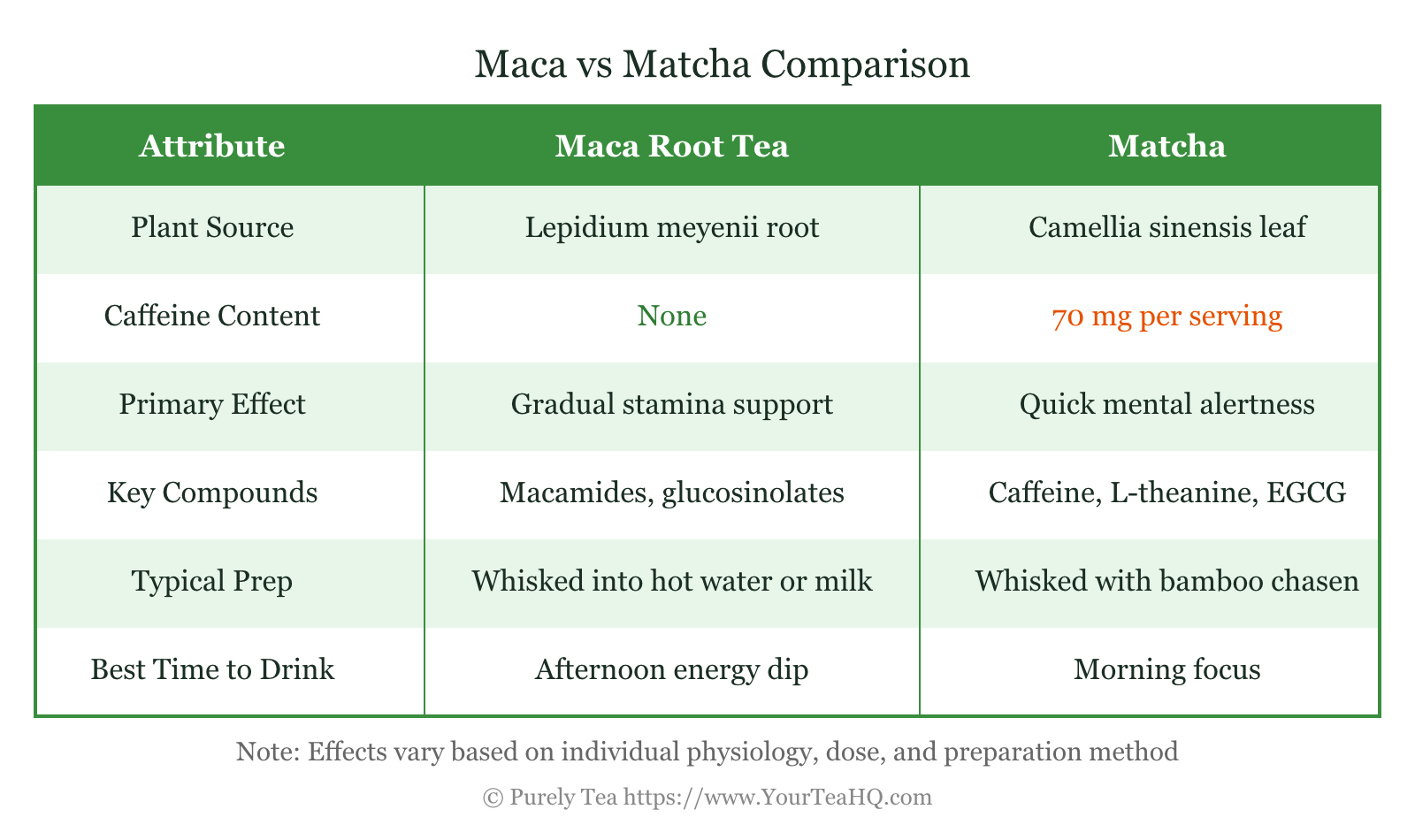
The name similarity between maca and matcha causes more mix ups than almost any other pairing in the tea and wellness world. Matcha is a stone ground green tea powder made from Camellia sinensis leaves, packed with caffeine and L theanine, and it delivers the kind of quick, focused alertness people associate with traditional tea. Maca root tea is a completely different plant family, contains no caffeine at all, and works through a slower, adaptogen style mechanism rather than a stimulant one.
Anyone deciding between the two should think about timing and intent rather than flavor alone, since one is built for immediate focus and the other for gradual, sustained support. The kind of naming confusion that shows up here is not unique to maca, and the detailed breakdown comparing how different green tea preparations deliver caffeine and antioxidants at different rates is a useful reference point for understanding just how much preparation method changes a plant’s effects, even within the same tea family.
How to Brew Maca Root Tea at Home
Brewing maca root tea is more forgiving than most tea preparation, largely because there are no delicate polyphenols to scorch or bitter compounds to worry about releasing too fast. A standard approach is to whisk about one teaspoon of gelatinized maca powder into a cup of hot water or warmed milk, then add a pinch of cinnamon or a small amount of vanilla extract to balance the earthy, slightly malty flavor.
Some people prefer blending it into a small amount of cold liquid first to avoid clumping before adding the rest of the hot water. Steeping is not really necessary since the powder dissolves rather than releasing flavor over time, so it comes together in under two minutes. For anyone used to the precision required in getting a smooth, lump free result from another powdered tea, maca is a considerably lower stakes process, though a milk frother or small whisk still helps prevent a gritty texture.
Ashley’s Note: My Afternoon Maca Ritual
My go to version is maca whisked into warm oat milk with a dash of cinnamon and a small spoon of honey, sipped around three in the afternoon when my energy usually dips. It does not hit like coffee, and that is exactly the point. I notice a steadier, less jittery kind of alertness that carries me through the rest of the workday without the crash that follows an afternoon espresso.
Who Should Be Cautious
Maca is generally considered well tolerated, but it is not automatically appropriate for everyone. People with thyroid conditions should talk to a doctor before adding maca regularly, since it belongs to the same plant family as other cruciferous vegetables that can influence thyroid function in sensitive individuals.
Anyone pregnant, nursing, or managing a hormone sensitive condition should also check with a healthcare provider first, given that much of the hormonal research so far has focused on postmenopausal women rather than broader populations. Starting with a small amount and watching how your body responds is a reasonable, low risk way to test tolerance before making maca root tea a daily habit.
There is also the question of dosage consistency, since maca is sold as a food product rather than a regulated pharmaceutical, which means potency can vary noticeably between brands. Most of the clinical research reviewed here used doses in the range of two to four grams per day, and there is no strong evidence that significantly higher amounts produce better results. Anyone taking thyroid medication, hormone therapy, or blood pressure medication should mention maca to their prescribing doctor simply because interactions have not been studied in depth, even though no major red flags have surfaced in the existing literature.
Conclusion
Maca root tea will not replace your morning coffee, and it is not a miracle hormone fix either. What the research does suggest is a gentle, adaptogen style support for stamina and hormonal wellbeing, backed by small but genuinely promising clinical trials. Treat it the way the Andean communities who cultivated it always have, as a steady, food based ritual rather than a fast acting remedy, and it earns a legitimate place in a thoughtful tea rotation.
Disclaimer: The information on Purely Tea is for educational purposes only and is not intended as medical advice. Always consult with a healthcare professional before making changes to your diet, especially if you have underlying health conditions.
References
- Brooks, N. A., Wilcox, G., Walker, K. Z., Ashton, J. F., Cox, M. B., & Stojanovska, L. (2008). Beneficial effects of Lepidium meyenii (Maca) on psychological symptoms and measures of sexual dysfunction in postmenopausal women are not related to estrogen or androgen content. Menopause, 15(6), 1157-1162.
- Stone, M., Ibarra, A., Roller, M., Zangara, A., & Stevenson, E. (2009). A pilot investigation into the effect of maca supplementation on physical activity and sexual desire in sportsmen. Journal of Ethnopharmacology, 126(3), 574-576.
- Lee, M. S., Shin, B. C., Yang, E. J., Lim, H. J., & Ernst, E. (2011). Maca (Lepidium meyenii) for treatment of menopausal symptoms: A systematic review. Maturitas, 70(3), 227-233.
- (2022). Evaluation of the effect of Lepidium meyenii Walpers in infertile patients: A randomized, double-blind, placebo-controlled trial. Phytotherapy Research.
- (2024). Effects of Maca (Lepidium meyenii Walp.) on physical performance in animals and humans: A systematic review and meta-analysis. Nutrients.
- Wang, S., et al. (2024). Exploring the chemical and pharmacological variability of Lepidium meyenii: A comprehensive review of the effects of maca. Frontiers in Pharmacology, 15.
