
Cooking With Tea: How to Use Loose Leaf and Tea Bags in Everyday Recipes
I still remember the first time I cooked with tea by accident. I had leftover Earl Grey steeping on the counter, and instead of pouring it down the sink, I used it to deglaze the pan I’d just seared chicken in. The result was this quietly floral, faintly smoky sauce that stopped everyone at the table mid-bite. That was the moment cooking with tea stopped being a novelty and became a fixture in my kitchen. If you’ve got tea in your cupboard, you’ve already got one of the most versatile flavor tools available.
Why Tea Works So Well in the Kitchen
Tea is not a simple leaf. Camellia sinensis, the plant behind black, green, white, and oolong teas, produces a remarkably layered set of compounds that respond to heat, fat, and time in ways that make it genuinely useful as a cooking ingredient.
The main players are polyphenols — a family of plant compounds that includes tannins and catechins. Tannins are responsible for that dry, slightly gripping sensation you get from a strong brew, and they interact with proteins in food, which is part of why tea has long been used in marinades for tougher cuts of meat. Research has confirmed that tea polyphenols can alter the structural configuration of muscle proteins, making fibers more tender when the meat is marinated or braised in tea (Gao et al., 2020).
Then there are the volatile aromatic compounds — the molecules responsible for tea’s distinctive smell. More than 600 volatile compounds have been identified across tea types, ranging from linalool (which gives tea its floral softness) to geraniol and limonene (which contribute citrus and brightness) (Zheng et al., 2016). These aromatics transfer into food during cooking, especially when tea is used in fats like butter or cream, which capture and hold scent molecules far more efficiently than water alone.
What determines how much of this survives the heat of cooking is the tea type and the method you use. Research published in the International Journal of Food Properties found that polyphenols are more stable at lower temperatures and in slightly acidic environments, and that significant degradation begins above 100°C (Zeng et al., 2017). This means a braise, a sauce, or a custard will preserve more of tea’s chemistry than high-heat dry roasting. But even in a hot oven, the aromatic compounds that survive still do meaningful flavor work.
Which Tea to Use for Which Tea Recipes
The biggest mistake people make when cooking with tea is reaching for whatever bag is closest. Different teas bring fundamentally different flavor profiles, and matching the tea to the dish makes the difference between a subtle background note and something that actually sings.
Black tea — particularly robust varieties like Assam — is the most forgiving option for savory cooking. Its deep, malty character holds up against red meat, soy-forward broths, and long braises. It also smokes beautifully. Earl Grey, technically a black tea, has bergamot oil pressed into the leaves, which gives baked goods a distinctly citrus-floral character that pairs especially well with butter and vanilla.
Green tea is more delicate and is better suited to grains, noodles, and light fish dishes. Its grassiness can turn bitter if you apply too much heat or steep the leaves too aggressively — a lesson that anyone who has ever over-brewed a cup can probably relate to. Matcha, which is powdered green tea, is in a category of its own: it suspends evenly in liquids and fats, making it ideal for custards, cookies, and glazes where a smooth, vivid result matters.
Herbal teas — chamomile, hibiscus, rooibos — bring color and botanical flavor without tannin heaviness. Hibiscus has a tartness that works like a fruit reduction in sauces and glazes. Chamomile has a faint apple-honey quality that pairs beautifully with cream-based desserts and citrus.
Sandy’s Science Corner: Why Fat Captures Tea Flavor Better Than Water
Tea’s volatile aromatic compounds — linalool, geraniol, limonene — are partly lipophilic, meaning they bind more readily to fat molecules than to water. When you steep tea leaves in warm cream or butter, the fat acts as a solvent that captures and holds these aromatics more efficiently. Research on tea VOCs confirms that terpenes constitute the dominant volatile fraction and are particularly susceptible to fat-phase absorption, which is why tea-infused cream tends to carry a richer, more persistent aroma than an equivalent water-based brew (Zeng et al., 2025).
Three Ways to Get Tea Into Your Food
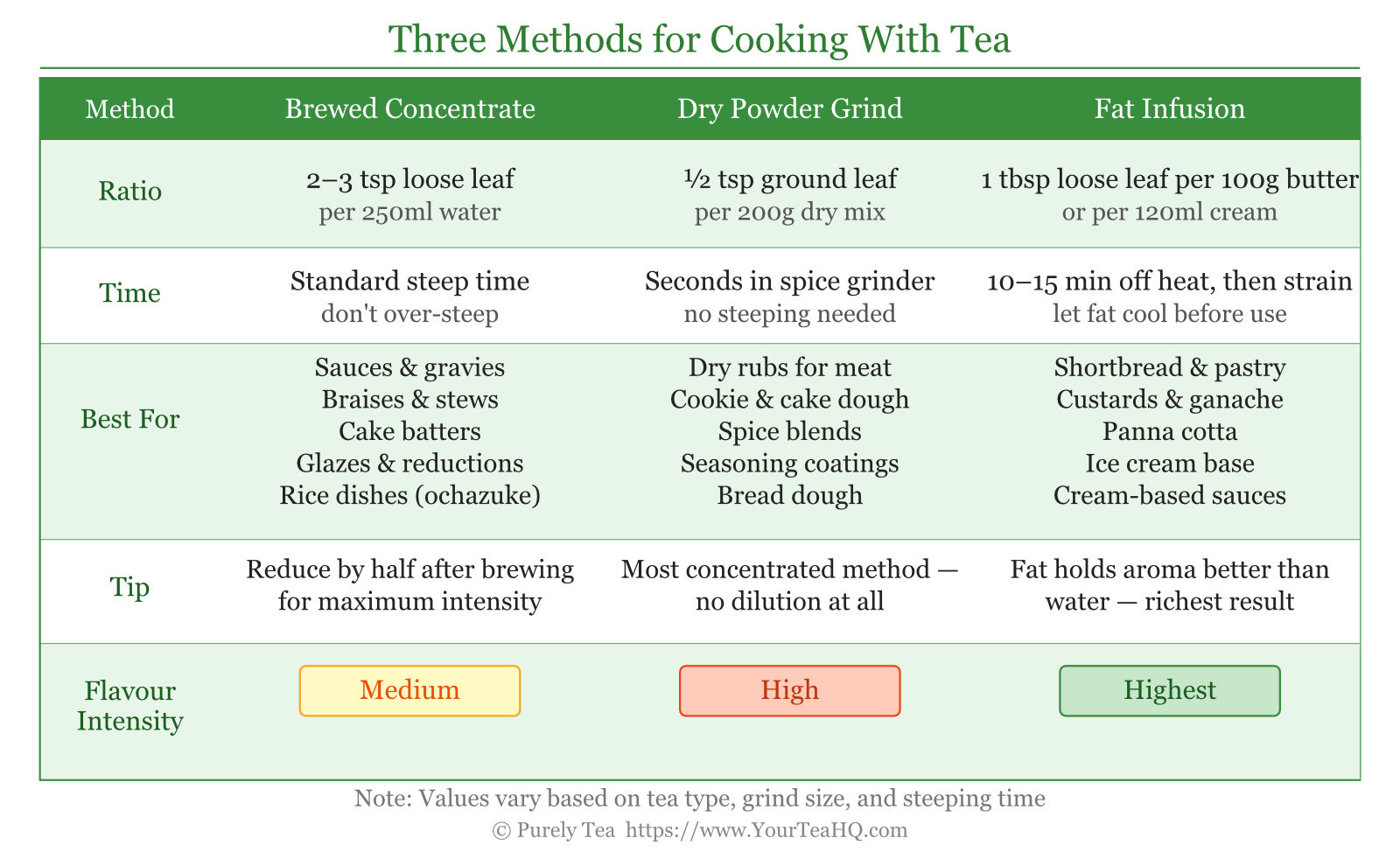
There is no single right method, and part of what makes cooking with tea interesting is that the technique you choose shapes the flavor outcome almost as much as the tea type itself.
The most accessible method is brewing a strong concentrate. Use two to three times the amount of tea you would for drinking, steep it for the same duration you normally would (longer does not always mean stronger — it mostly means more bitter), then reduce the liquid if you want even more intensity. This concentrate works as a braising liquid base, a component in sauces, or a liquid substitute in cake batters and glazes.
The second method is grinding dry leaves into a powder. A clean spice grinder handles this in seconds. Powdered tea blends directly into dry rubs, batters, and doughs without adding any moisture. The flavor is more concentrated than a brewed concentrate because nothing has been diluted, and the particles disperse evenly through whatever you are mixing.
The third method — and my personal favorite — is steeping the leaves directly in warm fat. Heat your butter or cream to just below a simmer, add the tea, let it sit off the heat for ten to fifteen minutes, then strain. What you get is a fat that has absorbed the tea’s aromatic oils in a way that water simply cannot replicate. Earl Grey butter made this way will change the way you think about shortbread forever.
Ashley’s Note: Start With What You Already Have
You do not need specialty loose leaf to start cooking with tea. I have made some of my best tea-infused dishes with ordinary supermarket bags. Rip open two or three bags of a good English Breakfast or Earl Grey, and use the loose leaves exactly as you would loose leaf. The grind is finer, which means it steeps and infuses faster — just watch the timing so it does not turn bitter on you.
Tea Flavor Pairings That Hold Up in the Kitchen
Flavor pairing with tea follows the same logic as most ingredient pairing: look for contrast or resonance. Tannin-rich teas like black tea create contrast when paired with fatty, rich foods — the tannins cut through the fat and prevent things from feeling heavy. This is why a braise in strong black tea works so well with beef short ribs or lamb shoulder.
Floral teas like Earl Grey or jasmine work through resonance — they amplify existing floral and aromatic notes in dishes already built around butter, vanilla, honey, and citrus. Matcha’s bitter, umami-edged character creates an interesting contrast when paired with white chocolate or condensed milk, softening the sweetness and adding depth.
Hibiscus brings tartness and a deep ruby color that behaves almost like pomegranate in a glaze or reduction. It pairs naturally with citrus, stone fruit, and anything that benefits from a little acidity. Rooibos, with its naturally sweet, slightly nutty profile and zero tannins, is one of the safest teas to cook with if you are new to this — it is hard to overdo and plays well with both savory spice blends and sweeter baked goods.
Savory Tea Recipes Worth Trying
Tea-smoked proteins are the most dramatic entry point into savory tea cooking. The classic technique uses dry loose leaf black tea layered in a wok with rice and sugar, then covered so the smoke infuses the meat or fish resting above. The aromatic compounds in the leaves volatilize from the heat and penetrate the surface of the protein, creating a wood-smoke-adjacent flavor with a distinctive tea character underneath.
Black tea braises are simpler and deeply satisfying. Brew a very strong pot of Assam or English Breakfast, use it as your braising liquid in place of stock or wine, and add aromatics as you normally would — onion, garlic, bay. The tannins interact with the connective tissue proteins over the long cook, contributing to tenderness while the malt and earth notes of the tea become part of the braise’s base flavor.
Green tea rice, known in Japan as ochazuke, is perhaps the most direct form of cooking with tea in a savory context. Leftover rice is warmed and topped with hot brewed green tea — traditionally a light, grassy style like sencha — along with toppings like pickled vegetables, nori, or salmon. The tea functions here as both a liquid and a flavor medium, warming and slightly softening the rice while contributing a clean, vegetal character.
Tea Recipes for Baking and Desserts
Baking is where many people first encounter tea recipes, and for good reason — the controlled, moderate heat of most baking preserves enough of tea’s aromatic compounds to make a real difference in the finished product.
Earl Grey shortbread is the gateway. Use the fat-infusion method: steep a generous handful of Earl Grey leaves in warm melted butter for fifteen minutes, strain, let the butter solidify in the fridge, then use it exactly as you would plain butter. The resulting shortbread carries the bergamot note throughout without any visible leaf or unusual texture.
Matcha works especially well in custard-based desserts — panna cotta, crème brûlée, ice cream base — because the powder disperses completely in the dairy without any textural disruption, and the slightly bitter, umami edge it carries provides a clean counterpoint to heavy sweetness. When using matcha in baking, reduce the sugar in the recipe slightly; matcha is bitter enough to make standard sweetness levels feel cloying.
Chai spice is a natural fit for cakes and muffins, and the approach that gives the most flavor is steeping whole chai — either a well-spiced loose blend or a quality chai bag — directly in your milk or cream before adding it to the batter. The spices and black tea base transfer into the dairy together, giving a more integrated result than simply adding spice powders to the dry mix.
How Much Tea to Use — And When It’s Too Much
The common instinct is to use more tea to get more flavor, but beyond a certain point, more tea means more tannin bitterness rather than more complexity. For a brewed concentrate intended for cooking, two to three teaspoons of loose leaf per 250ml of water (roughly double a standard cup) is a solid starting point. Taste before you commit to a full batch — you want intensity, not astringency.
For dry grinding, half a teaspoon of powdered leaf per 200g of flour or dry mixture is a reasonable starting point for baked goods. For fat infusion, one tablespoon of loose leaf per 100g of butter or per 120ml of cream gives a clear flavor without overwhelming the base. If you are using tea bags, remember that the fine grind extracts faster — reduce your steep time by about a third compared to loose leaf.
One more thing worth knowing: because tea is a real food ingredient with functional compounds, anyone who monitors their intake of tannins or caffeine for health reasons — including those managing iron absorption — should keep that in mind when using strong black or green tea concentrates in cooking. The compounds that make tea interesting in a pan are the same ones that are active in the body.
Your Kitchen Already Has Everything You Need
Cooking with tea does not require a special pantry or an advanced skill set. The teas most people already own — a box of Earl Grey, a few bags of green tea, maybe some chamomile sitting at the back of a drawer — are genuinely useful ingredients that most kitchens have never fully put to work. Start with the fat infusion method, since it produces the most noticeable results with the least risk of bitterness. Brew Earl Grey into your butter, taste it, and you’ll understand immediately why this has been a pastry kitchen trick for decades. From there, the rest of it opens up naturally.
Disclaimer: The information on Purely Tea is for educational purposes only and is not intended as medical advice. Always consult with a healthcare professional before making changes to your diet, especially if you have underlying health conditions.
References
- Zeng, L., Ma, M., Li, C., & Luo, L. (2017). Stability of tea polyphenols solution with different pH at different temperatures. International Journal of Food Properties, 20(1), 1–18. https://doi.org/10.1080/10942912.2014.983605
- Gao, M. R., Xu, Q. D., & Zeng, W. C. (2020). Effect of tea polyphenols on the tenderness of yak meat. Journal of Food Processing and Preservation, 44(7), e14433.
- Zheng, X. Q., Li, Q. S., Xiang, L. P., & Liang, Y. R. (2016). Recent advances in volatiles of teas. Molecules, 21(3), 338.
- Zeng, Q., Wang, H., Tuo, J., Ding, Y., & Cao, H. (2025). Volatile organic compounds in teas: Identification, extraction, analysis, and application of tea aroma. Foods, 14(15), 2574.
- EFSA ANS Panel. (2018). Scientific opinion on the safety of green tea catechins. EFSA Journal, 16(4), e05239.
- Bortolini, D. G., Haminiuk, C. W. I., Pedro, A. C., Fernandes, I. A. A., & Maciel, G. M. (2021). Processing, chemical signature and food industry applications of Camellia sinensis teas: An overview. Food Chemistry: X, 12, 100160.
- Al-Hijazeen, M., Lee, E. J., Mendonca, A., & Ahn, D. U. (2016). Effects of tannic acid on lipid and protein oxidation, color, and volatiles of raw and cooked chicken breast meat during storage. Antioxidants, 5(2), 19.
