
What Is Genmaicha? The Toasty Japanese Green Tea You’ll Want Every Morning
The first time I brewed a cup of genmaicha, I wasn’t expecting much. It looked like regular green tea, but the moment hot water hit those leaves, something unexpected happened: the kitchen smelled like buttered popcorn crossed with a grassy meadow. Genmaicha is a Japanese green tea blended with roasted brown rice, and that combination produces one of the most comforting, low-caffeine cups you can make on a weekday morning. If you’ve ever wanted the ritual of green tea without the sharp, sometimes bitter edge, this might be your answer.
What Is Genmaicha?
Genmaicha (玄米茶) translates literally as “brown rice tea” in Japanese — “genmai” meaning brown rice and “cha” meaning tea. The drink is made by blending green tea leaves, most commonly bancha or sencha, with kernels of roasted brown rice. Some of those rice kernels puff up during roasting, which is why genmaicha is sometimes called “popcorn tea” in English-speaking markets.
Historically, the tea has roots in economy. Rice was added to extend tea leaves and make them go further, which made the blend affordable for everyday households. Today, that origin story is largely irrelevant — genmaicha is consumed across all income levels in Japan and has become a staple in tea shops worldwide. You’ll also find a variety called matcha-iri genmaicha, which adds a dusting of ground matcha powder to the blend, deepening the green tea flavor and boosting the antioxidant content.
What Does Genmaicha Taste Like?
The flavor profile sits somewhere between grassy green tea and toasty grain — think of a light, umami-edged broth with a subtle nuttiness and none of the astringency that sometimes comes from straight green tea. The roasted rice adds warmth and a slightly sweet note that lingers after the sip.
I find it works particularly well in the morning because it doesn’t overwhelm the palate. If you’ve been turned off by green tea in the past because it tasted too sharp or vegetal, genmaicha tends to be much more forgiving. The flavor also shifts noticeably depending on how you brew it — cooler water and a shorter steep keeps things mild and sweet, while hotter water or a longer steep brings out more of the green tea character.
The matcha-iri version, if you try it, adds a layer of grassy depth and a slightly thicker mouthfeel, comparable to a very diluted matcha but softer in intensity.
Sandy’s Science Corner: The Maillard Reaction in Your Cup
When brown rice is roasted, it undergoes the Maillard reaction — a chemical process where heat causes amino acids and natural sugars in the grain to react, producing dozens of new aroma compounds including pyrazines and furans. These are the molecules responsible for genmaicha’s signature nutty, toasty smell. It’s the same chemistry behind roasted coffee and fresh bread, which is part of why the aroma feels so instinctively comforting.
Genmaicha Tea Benefits: What the Research Suggests
The health properties of genmaicha largely come from its green tea base. Because the rice replaces a portion of the leaves, the concentration of bioactive compounds is lower than in straight sencha or matcha — but the catechins, particularly epigallocatechin gallate (EGCG), are still present and active.
Research confirms that EGCG is a potent antioxidant capable of neutralizing free radicals and reducing oxidative stress at the cellular level (Khan & Mukhtar, 2007). Tea polyphenols more broadly have been shown to exert antioxidant, anti-inflammatory, and potentially cardioprotective effects through their influence on cellular signaling pathways (Truong & Jeong, 2021). A 2025 review published in Foods confirmed that green tea possesses antioxidant and anti-inflammatory activity, though it also noted that translating those effects into clear clinical outcomes in humans remains an active area of research, partly due to the low bioavailability of catechins after digestion (Radeva-Ilieva et al., 2025).
Genmaicha’s genmaicha tea benefits don’t stop at antioxidants. The L-theanine naturally present in the green tea base plays a role in how you feel after drinking it. Research shows that L-theanine promotes alpha wave activity in the brain, associated with a calm but alert mental state, and may modulate the blood pressure response to stress (Nobre et al., 2008). When paired with even modest amounts of caffeine — as it naturally is in tea — theanine has been shown to help produce a focused, even mental state without the jitteriness often associated with coffee (Csupor et al., 2016).
The roasted rice component itself doesn’t contribute significant bioactive compounds, but it does dilute the tannin content of the tea, which is one reason genmaicha tends to be gentler on the stomach than more concentrated green teas. If you’ve had issues drinking regular tea on an empty stomach, the lower tannin load here may make a meaningful difference.
How Much Caffeine Is in Genmaicha?
Genmaicha caffeine levels are notably lower than most other green teas, and that’s a direct result of the blending. Because roughly half the volume of the blend is roasted rice rather than tea leaves, the caffeine per cup drops significantly. A standard 8 oz cup of genmaicha typically contains somewhere between 15 and 30 mg of caffeine, compared to 25–50 mg in plain sencha or matcha. For context, caffeine in green tea varies quite a bit based on the base cultivar, growing conditions, and brewing method — genmaicha sits at the lower end of that range.
This makes it a practical option for people who are caffeine-sensitive, those who want something warm in the afternoon without disrupting sleep, or anyone stepping down from coffee who still wants a gentle lift. It carries just enough caffeine to take the edge off morning fatigue without the kind of spike that leaves you watching the ceiling at 2 a.m.
How to Brew Genmaicha the Right Way
Genmaicha is one of the more forgiving Japanese green teas to brew, but there are still a few variables worth paying attention to. Water temperature matters most. I aim for 75–80°C (167–176°F) — hot enough to extract flavor from both the leaves and the rice, but not so hot that you scorch the green tea and release harsh tannins.
Use about one teaspoon of loose-leaf genmaicha per 6–8 oz of water and steep for 1 to 2 minutes. Pull the leaves before the timer hits 2 minutes if you want something sweeter and milder. Leave it a touch longer and the green tea character becomes more pronounced.
The water you use also matters more than most people expect. Minerals in hard tap water can bind to polyphenols and flatten the flavor; water hardness affects tea extraction in ways that change both taste and color. Filtered or soft water gives you a cleaner, brighter cup. Genmaicha holds up well to a second steep — just add 30 seconds to your time and expect a lighter, sweeter infusion. The same guidance on steeping green tea correctly applies here: when in doubt, go cooler and shorter rather than hotter and longer.
Ashley’s Note: My Afternoon Reset Cup
Genmaicha has become my 3 p.m. ritual. When the post-lunch fog settles in and coffee feels like too much, I reach for a small kyusu of genmaicha — nothing fancy, just a teaspoon of loose leaf, water just off the boil that’s been left to cool for a minute or two, and about 90 seconds of patience. The toasty smell alone changes my mental state before I’ve even taken a sip. It’s the tea equivalent of a deep breath.
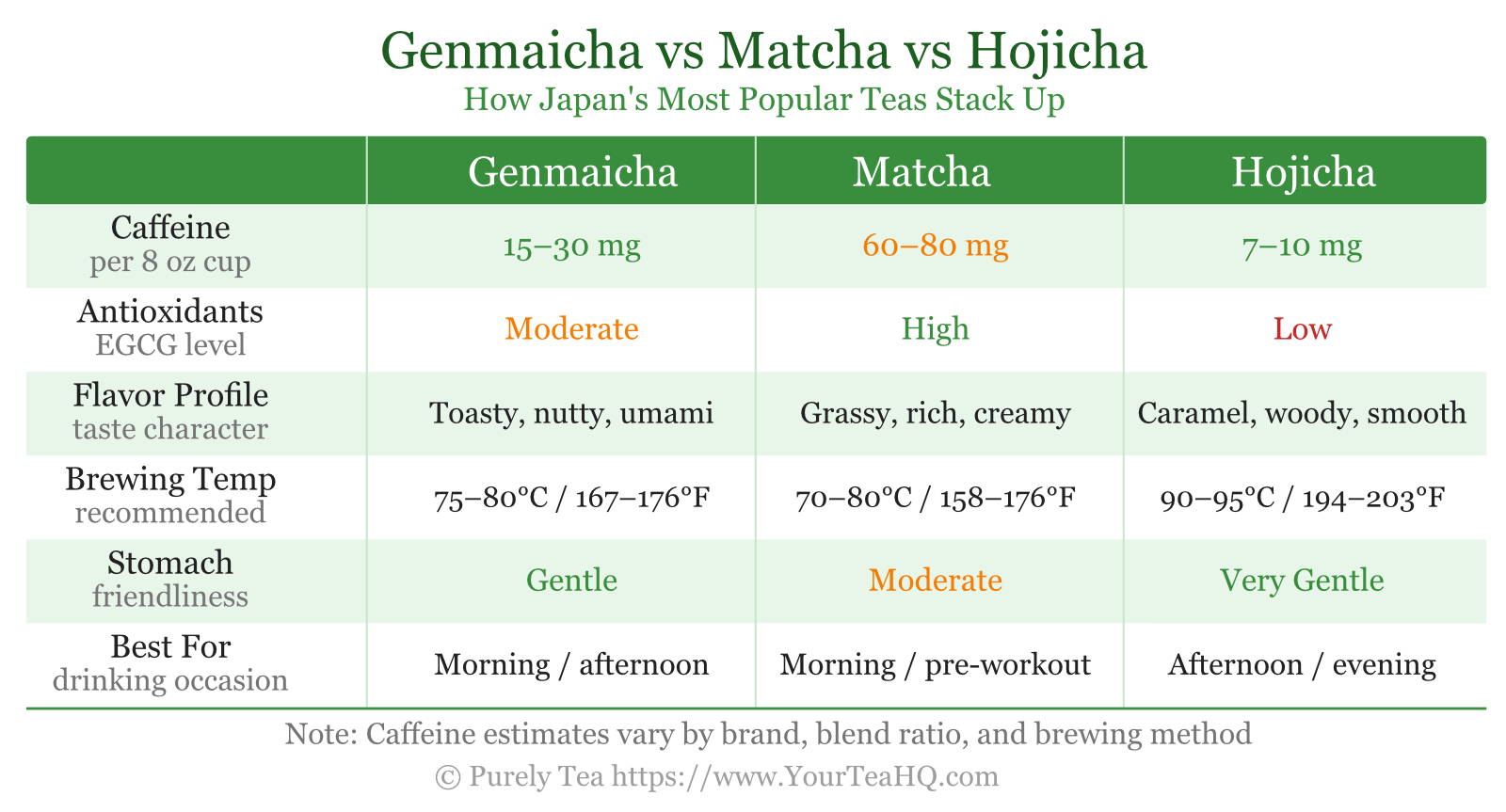
Genmaicha vs Matcha and Hojicha: Which Japanese Tea Should You Choose?
These three teas come up together often, and for good reason — they’re all popular in Japan, all made from Camellia sinensis, and all quite different from each other in practice.
Genmaicha vs matcha is a useful comparison for anyone thinking about antioxidants. Matcha, which is made from finely ground shade-grown leaves, contains significantly more EGCG per serving since you’re consuming the entire leaf rather than an infusion. The detailed breakdown of how those compounds compare between sencha and matcha at the molecular level helps explain why matcha is often positioned as the higher-potency option. Genmaicha, by contrast, is a gentler, lower-concentration cup — better suited for daily casual drinking than targeted supplementation.
Genmaicha vs hojicha is a closer comparison in terms of caffeine and approachability. Both are low in caffeine relative to other green teas, and both have a toasty character. The key difference is in the base: hojicha is made by roasting the tea leaves themselves, which breaks down much of the caffeine and most of the catechins — producing a reddish-brown, smooth cup with very little of the green tea character. Genmaicha retains the green tea leaves intact, so you get more of the catechins and L-theanine alongside the roasted note. If you want more green tea benefit with a lower-caffeine profile, genmaicha edges ahead. If you want something almost entirely mellow that’s safe for evenings, hojicha wins.
What to Look for When Buying Genmaicha
The quality of genmaicha varies considerably. Higher-grade versions use sencha as the base tea, which produces a more vibrant, grassy flavor alongside the rice. Lower-grade versions typically use bancha — harvested later in the season from older leaves — which results in a flatter, sometimes slightly stale taste. Neither is wrong, but if you want the fuller green tea flavor and more of the genmaicha tea benefits, seek out a sencha-based blend.
Look for products that list the tea type on the label. A matcha-iri version will usually be labeled clearly and will have a noticeably darker green hue in the dry blend. For loose-leaf genmaicha, freshness shows in the color — bright green leaves mixed with golden or pale rice kernels. If the leaves look brownish or the rice looks grey, the tea is likely stale.
Teabags are fine for convenience, but loose leaf generally gives you better flavor and more control over steep time and ratio, which matters a lot with a tea this delicate.
Wrapping Up
Genmaicha is one of those teas that doesn’t ask much of you. It’s easy to brew, low in caffeine, gentle enough for most stomachs, and genuinely comforting in a way that feels earned rather than manufactured. The antioxidants are real, the L-theanine is working quietly in the background, and the flavor is something that grows on you fast. If your tea shelf is mostly occupied by English breakfast and chamomile, a bag of good genmaicha might be exactly the kind of discovery you didn’t know you were looking for.
Disclaimer: The information on Purely Tea is for educational purposes only and is not intended as medical advice. Always consult with a healthcare professional before making changes to your diet, especially if you have underlying health conditions.
References
- Radeva-Ilieva, M., Stoeva, S., Hvarchanova, N., & Georgiev, K. D. (2025). Green tea: Current knowledge and issues. Foods, 14(5), 745.
- Khan, N., & Mukhtar, H. (2007). Green tea catechin, epigallocatechin-3-gallate (EGCG): Mechanisms, perspectives and clinical applications. Biochemical Pharmacology, 82(12), 1807–1821.
- Truong, V. L., & Jeong, W. S. (2021). Cellular defensive mechanisms of tea polyphenols: Structure-activity relationship. International Journal of Molecular Sciences, 22(17), 9109.
- Nobre, A. C., Rao, A., & Owen, G. N. (2008). L-theanine, a natural constituent in tea, and its effect on mental state. Asia Pacific Journal of Clinical Nutrition, 17(S1), 167–168.
- Csupor, D., Szabo, A., Patai, A., & Hohmann, J. (2016). Theanine and caffeine content of infusions prepared from commercial tea samples. Pharmacognosy Magazine, 12(45), 75–79.
- Yan, Z., Zhong, Y., Duan, Y., Chen, Q., & Li, F. (2020). Antioxidant mechanism of tea polyphenols and its impact on health benefits. Animal Nutrition, 6(2), 115–123.
{
“@context”: “https://schema.org”,
“@type”: “FAQPage”,
“mainEntity”: [
{
“@type”: “Question”,
“name”: “What is genmaicha?”,
“acceptedAnswer”: {
“@type”: “Answer”,
“text”: “Genmaicha is a Japanese green tea blended with roasted brown rice. The combination produces a nutty, toasty flavor with lower caffeine than standard green tea. It is sometimes called ‘popcorn tea’ because some rice kernels puff up during roasting.”
}
},
{
“@type”: “Question”,
“name”: “How much caffeine is in genmaicha?”,
“acceptedAnswer”: {
“@type”: “Answer”,
“text”: “Genmaicha typically contains 15–30 mg of caffeine per 8 oz cup, making it one of the lower-caffeine green teas available. The roasted rice replaces a portion of the tea leaves, which reduces the overall caffeine content compared to plain sencha or matcha.”
}
},
{
“@type”: “Question”,
“name”: “What are the health benefits of genmaicha?”,
“acceptedAnswer”: {
“@type”: “Answer”,
“text”: “Genmaicha tea benefits come primarily from its green tea base, which contains catechins like EGCG with antioxidant and anti-inflammatory properties. It also contains L-theanine, which may support a calm, focused mental state. The lower tannin content makes it gentler on the stomach than most green teas.”
}
},
{
“@type”: “Question”,
“name”: “How do you brew genmaicha?”,
“acceptedAnswer”: {
“@type”: “Answer”,
“text”: “Use water at 75–80°C (167–176°F) and steep one teaspoon of loose-leaf genmaicha per 6–8 oz of water for 1–2 minutes. Avoid boiling water, which can make the tea bitter. Genmaicha can be re-steeped once or twice by adding 30 seconds to each subsequent steep.”
}
},
{
“@type”: “Question”,
“name”: “What is the difference between genmaicha and hojicha?”,
“acceptedAnswer”: {
“@type”: “Answer”,
“text”: “Both are low-caffeine Japanese teas with a toasty character. Genmaicha blends green tea leaves with roasted rice and retains more catechins and L-theanine. Hojicha is made by roasting the tea leaves themselves, which breaks down most catechins, resulting in an even lower caffeine content and a caramel-like flavor.”
}
},
{
“@type”: “Question”,
“name”: “What is matcha-iri genmaicha?”,
“acceptedAnswer”: {
“@type”: “Answer”,
“text”: “Matcha-iri genmaicha is a version of genmaicha with added matcha powder. The matcha deepens the green tea flavor, increases the antioxidant content, and gives the dry blend a noticeably darker green color. It brews bolder than standard genmaicha and benefits from a slightly shorter steep time.”
}
},
{
“@type”: “Question”,
“name”: “Is genmaicha good for sensitive stomachs?”,
“acceptedAnswer”: {
“@type”: “Answer”,
“text”: “Yes. Because the rice replaces a portion of the tea leaves, genmaicha has lower tannin content than most green teas, which makes it gentler on the stomach. It is often well-tolerated by people who find regular green tea or black tea irritating, especially when consumed on an empty stomach.”
}
}
]
}
